
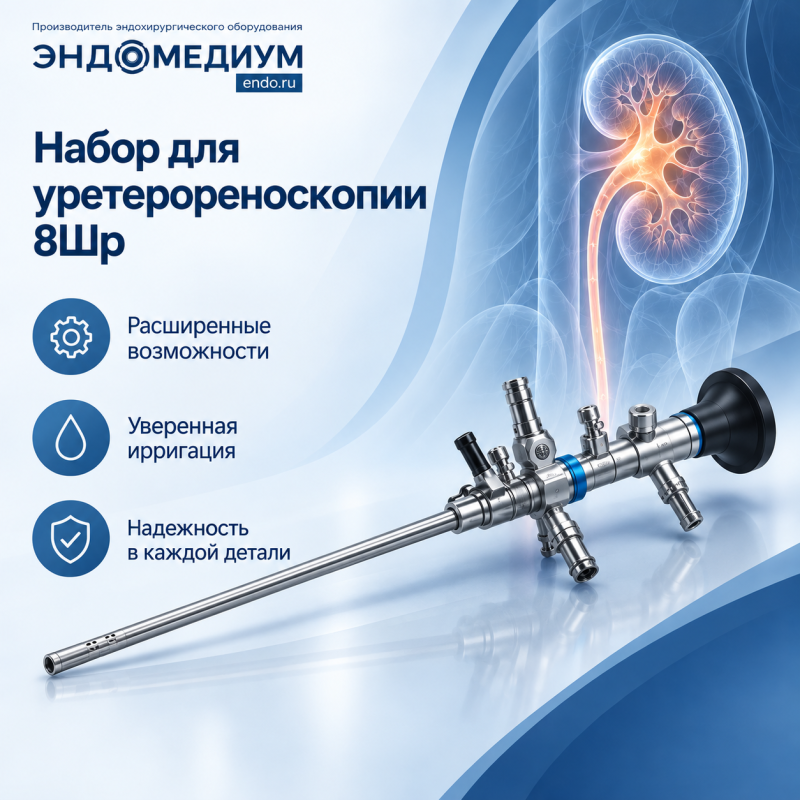
Ureterorenoscopy kit 8 Fr
Ureterorenoscopy kit 8 Fr EndoUro® The main clinical application of the kit is the urethral and urethral urethral urethral and urea urethral urethral With half-rigid ureterenoscopics (URS) In the case of urinary disease, endoscopy diagnosis and treatment manipulation under direct visual control.
Ureterorenoscopy provides direct endoscopy access to the urinary and allows visual evaluation of its clearance and mucousness, determination of the position of the nodule or pathologically modified site and necessary manipulation through natural urine tracks without open surgical access.
Clinical application of ureterenoscopy
The semi-rigid uretheroscopy is widely used in modern endourology for the diagnosis and treatment of urinary diseases. Transurethral endoscopy allows urinary path examination and treatment procedures under constant visual control.
One of the main applications of URS is Treatment of urinary stones. The ureterrenoscope allows for the localization of the nodule, the evaluation of the environmental mucous condition, contact ltotripsy with compatible equipment and the control of subsequent removal of stone or its fragments.
Treatment of the urea rinder stones
In uretherolytic ureterenoscopy, the endoscopy can be brought directly to the nodule area. Depending on the size, shape and position, the stone can be extracted entirely or pre-fractured using a compatible contact system for lithotripsy.
After the nodule is destroyed, individual fragments can be captured and removed under endoscopy control. Visualization of the operating field enables the doctor to control the position of the lithotripsy tool, the fragmentation process and the subsequent removal of the available fragments.
This approach is consistent with the modern concept stone management, The endourological equipment used by leading producers: visual control, contact lithotripsis and subsequent extraction of fragments are considered as successive stages of endoscopic treatment of urinary disease280880search7turn280880search11
Contact lithotripsis at URS
Ureterorenoscopy can be combined with various contact methods for lithotripsy. Modern endourology uses laser, ballistic and other compatible technologies to bring energy directly to the stone surface under visual control.
The doctor can position the lithotripsy instrument relative to the nodule, monitor its fragmentation and evaluate the particles formed. Once the lithotripsia is complete, the available fragments can be removed by endoscopy-sustained instruments.
Extraction of stones and fragments
Ureterorenoscopy can be used for mechanical capture, movement and extraction of nodules and their fragments from the urethermal rind. The choice of disposal method depends on the size of the stone, its location and surgical tactics.
Mechanical extraction can be performed as an independent step with suitable nodule sizes or after prior fragmentation. Endoscopy control allows a doctor to visually assess the location of the exciting instrument and the extraction process.
Diagnostic ureterenoscopics
Ureteroenoscopy is not only used for urinary disease; the method allows direct examination of the mucous urinary urea and accessible upper urinary tracts and can be used in diagnostic examinations of patients suspected of pathological changes in the urinary or kidney plaque.
Endoscopy visualization allows for the assessment of the nature and location of the changes identified and for the implementation of the necessary measures A targeted biopsy This application of uretherorenoscopy is separately identified by CARL STORZ for diagnosis and treatment of upper urinary tract diseases, including supertrack urothelial carcinoma (UTUC). citeturn280880search0turn280880search1turn280880search6
Diagnostics of pathological changes in upper urinary tracts
If a uretherorenoscopy is suspected of changing the urotolelium, it can be used to specify endoscopy diagnosis. Direct examination allows the doctor to assess the surface of the mucous, shape and prevalence of the visually determined pathological site.
If clinical evidence is available, a biopsy tool can be performed through the service channel of a compatible endoscopic system to obtain a tissue sample. Olympus also considers uretheroscopy as a method of diagnosis of urinary and kidney diseases, and in some systems focuses on improved visualization of musculos and early detection of tumor changes in the upper urinal tract267045search13turn280880search5
Ureterorenoscopy in urinary struts
Semi-rigid ureterenoscopy can be used in diagnostics Boiler skins and urea structures. Endoscopy studies allow visual determination of the location of the constriction area and assessment of the urea condition in the pathological change zone.
Depending on the clinical situation, URS may be used as a diagnostic phase or as part of endourological treatment. CARL STORZ assigns urea urea treatment to selected areas of endourological systems280880search4
Endoscopy manipulations under visual control
One of the key benefits of ureterrenoscopy is the possibility of combining diagnosis and treatment in one endoscopy intervention. Visual control may include lithotripsis, stone capture and extraction, fragment removal, targeted biopsy and other manipulation using compatible endoscopic tools.
This principle allows the doctor to directly control the instrument ' s position on the nodule or pathological site and to follow the necessary steps in the procedure in a consistent manner.
Semi-rigid ureterenoscopics 8 Fr
Semi-rigid ureterenoscopes are particularly needed for endoscopy treatment urea rinding stones. Richard Wolf clearly indicates that semi-rigid URS is used primarily for ureteral nodules, while flexible ureterenoscopy is more commonly used for the pathology of the kidney casket-lohane system267045search9
Ureterorenoscopy access through natural urine routes allows diagnostic and curative manipulation without skin section and provides direct visualization of the intervention zone.
Main clinical challenges
Ureterorenoscopy kit EndoUro® may be used in endourological interventions related to:
- diagnostic urethero-scopy (URS);
- Endoscopy urinary and upper urinary tracts;
- treatment of the urinary stones;
- Visual location of nodules;
- contact lithotripsy compatible with;
- by the seizure and extraction of stones;
- by removing fragments after lithotripsy;
- diagnosis of pathological changes in the mucous urinary and kidney plaque;
- Endoscopy biopsy;
- urea trim and constriction diagnostics;
- Conducting therapeutic and diagnostic endoscopy manipulations under visual control.
Ureterorenoscopy EndoUro® in modern endourology
Ureterorenoscopy kit 8 Fr EndoUro® The main application is endoscopy treatment for urinary disease with visual stone containment, contact lithotripsy and subsequent recovery of nodules and their fragments.
At the same time, urethero-escopy can be used for diagnostic examination of the mucous urinary and kidney loaf, assessment of strhythtics and other pathological changes, and for purpose biopsy under direct endoscopy control.
Specific readings, counter-intelligence, urethero-renoscopy techniques, lithotrips and compatibility with endoscopic instruments and equipment are determined by the registration and operational documentation of the relevant medical products.
| 1 | арт. 6010-60, Ureterorenoscope 8–9.8 Fr EndoUro® Ureteroscope, diameter 8–9.8 Fr, direction of observation 5°, working length 430 mm, Irrigation and/or probe channel 5,2 × 6.2 Fr Tool-based tool channel 5 Fr Number: 1 unit | |
| 2 |  | арт. 1701-065, biopsicle pinches, semi-rigid, 5 Fr, length 60 cm, for ureterenoscopes Biopsicle pinches, semi-rigid, 5 Fr, length 60 cm, for ureterenoscopes Number: 1 unit |
| 3 |  | арт. 1701-165, biopxial pinches, flexible, 5 Fr, length 60 cm, for ureterenoscopes Biopxial pinches, flexible, 5 Fr, length 60 cm, for ureterenoscopes Number: 1 unit |
| 4 |  | арт. 1702-065, capture pins, half-hard, 5 Fr, length 60 cm, for ureterenoscopes Capture pins, half-hard, 5 Fr, length 60 cm, for ureterenoscopes Number: 1 unit |
| 5 |  | арт. 1702-165, capture pins, flexible, 5 Fr, length 60 cm, for ureterenoscopes Capture pins, flexible, 5 Fr, length 60 cm, for ureterenoscopes Number: 1 unit |
| 6 |  | арт. 1703-065, pEREZ-CASTRO Rock Track, semi-rigid, 5 Fr, length 60 cm, for ureterenoscopes PEREZ-CASTRO Rock Track, semi-rigid, 5 Fr, length 60 cm, for ureterenoscopes Number: 1 unit |
| 7 | 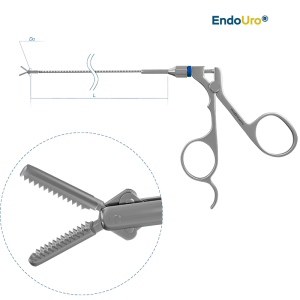 | арт. 1703-165, pEREZ-CASTRO Rock Track, Flexible, 5 Fr, length 60 cm, for ureterenoscopes PEREZ-CASTRO Rock Track, Flexible, 5 Fr, length 60 cm, for ureterenoscopes Number: 1 unit |
| 8 |  | арт. 1704-065, tricks for large rocks and fragments, semi-rigid, 5 Fr, length 60 cm, for ureterenoscopes Tricks for large rocks and fragments, semi-rigid, 5 Fr, length 60 cm, for ureterenoscopes Number: 1 unit |
| 9 | 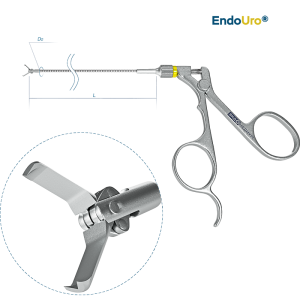 | арт. 1704-165, tip-tubes for large rocks and fragments, flexible, 5 Fr, length 60 cm, for ureterenoscopes Tip-tubes for large rocks and fragments, flexible, 5 Fr, length 60 cm, for ureterenoscopes Number: 1 unit |
| 10 |  | арт. 1705-065, clamp for the extraction of stones, semi-rigid, 5 Fr, length 60 cm, for ureterenoscopes Clamp for the extraction of stones, semi-rigid, 5 Fr, length 60 cm, for ureterenoscopes Number: 1 unit |
| 11 | 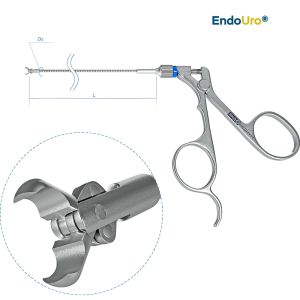 | арт. 1705-165, rock clamp, flexible, 5 Fr, length 60 cm, for ureterenoscopes Rock clamp, flexible, 5 Fr, length 60 cm, for ureterenoscopes Number: 1 unit |
| 12 |  | арт. 1706-065, grasper pins, half-rigid, 5 Fr, length 60 cm, for ureterenoscopes Grasper's pins, half-hard, 5 Fr, length 60 cm, for ureterenoscopes Number: 1 unit |
| 13 | 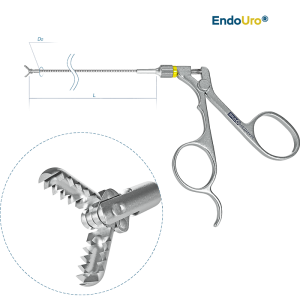 | арт. 1706-165, grasper pins, flexible, 5 Fr, length 60 cm, for ureterenoscopes Grasper's pins, flexible, 5 Fr, length 60 cm, for ureterenoscopes Number: 1 unit |