
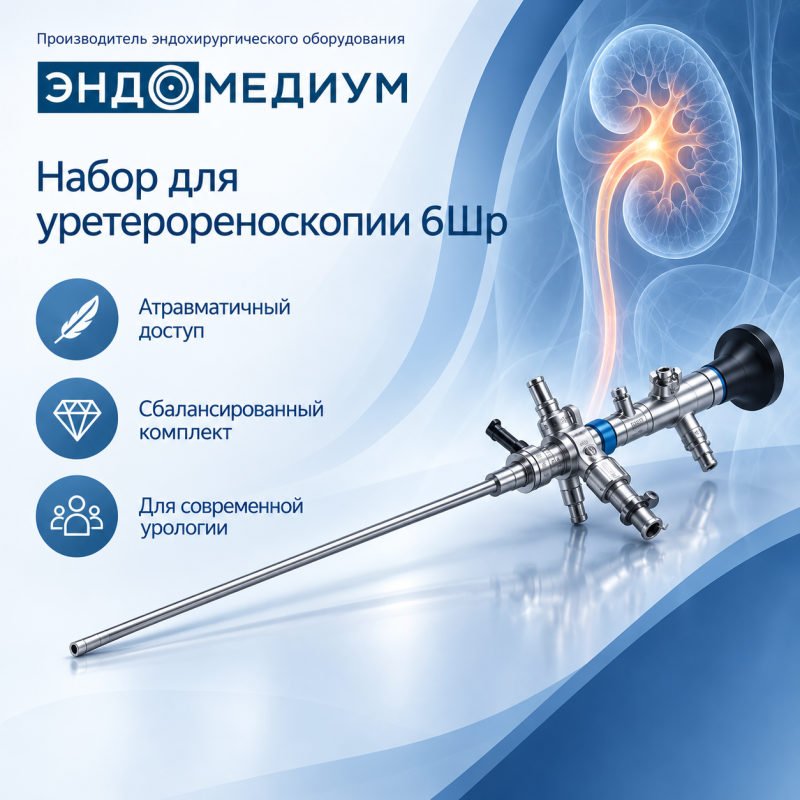
Ureterorenoscopy kit 6 Fr
Ureterorenoscopy kit 6 Fr EndoUro® The purpose of the kit is to provide diagnostic and endoscopy interventions on the urinary and upper urinary tracks with transurethral access — Half-rigid ureterenoscopics (URS) In the case of urinary disease, and in the case of diagnostic and therapeutic manipulation under direct endoscopy control.
Ureterorenoscopy allows visual examination of the urea urea duct light and accessible calyx-lohane system sections, determination of the location of the nodule or pathologically modified site and execution of the necessary endourological intervention without open surgical access.
Clinical application of ureterenoscopy
Transurethral access allows for the use of an endoscope through the urinary canal and the bladder directly into the wiener and for manipulation under constant visual control.
One of the main indicators for urethero-renoscopy is Mochacama disease and presence of urinary nodules. The method allows for the determination of the location of the stone, the evaluation of the state of the surrounding mucous, the execution of contact lithotripsy with compatible equipment and the removal of the formed fragments by endoscopy tools.
Treatment of the urea rinder stones
In uretherolythias, a semi-rigid ureterrenoscope provides direct endoscopic access to the nodule. Depending on its size, position and the surgical tactics chosen, the stone can be removed in whole or pre-fractured by a compatible contact system for lithotripsy.
After the nodule is destroyed, the formed fragments can be captured and recovered under endoscopy control. The ability to visually monitor each stage of intervention helps the doctor to assess the position of the stone, the fragmentation process and the completeness of the removal of the available fragments.
This treatment is consistent with the modern approach to treatment URS and endoscopy treatment of urolithiasis, used in the world ' s leading endourological equipment systems.
Contact lithotripsis at URS
Ureterorenoscopy can be combined with contact lithotripsia, where energy is directly brought to the nodule through the endoscopic system service channel.
Under direct visual control, a doctor can position a lithotripsic instrument over the stone surface, perform consistent fragmentation and control the particles formed. After lithotrips, the available fragments can be removed by mechanically exciting tools.
Extraction of stones and their fragments
The kit may be used for mechanical capture, movement and extraction of nodules and their fragments from the urinary. Depending on the clinical situation, the doctor may choose the different types of endoscopy capture, depending on the size, shape and position of the stone.
Mechanical extraction is particularly required after contact lithotripsy when it is necessary to remove some large fragments that prevent free disposal or to conduct an audit of the nodule area.
Diagnostic ureterenoscopics
Ureterorenoscopy is not used only for urinary disease; the method provides direct visualization of the mucous urinary and accessible kidney loaf and can be used for diagnostic urinary tracts.
The endoscopic study allows for the evaluation of urinary ducting, mucous condition, localization of pathologically modified sites and the nature of the changes identified Targeting biopsy material under visual control for further morphological research.
Diagnostics of pathological changes in upper urinary tracts
If there are suspicious changes, urethero-renoscopy can be used as a method to refine endoscopy diagnosis of urinary and kidney laceration diseases.
Visual monitoring allows the doctor to examine the modified site directly and, if the evidence is available, to perform a targeted biopsy, which is the approach used in the world endourological practice in the examination of patients suspected of pathological changes in the twilight of the upper urinary tracts.
Ureterorenoscopy in urinary struts
Another area of clinical application of hard and semi-rigid ureterenoscopy is diagnosis Boiler skins and urea structures. Endoscopy studies allow for localization and visual assessment of the area of constriction.
Depending on the clinical situation and the method chosen by the doctor, uretheroscopy can be used as a diagnostic or therapeutic endourological intervention for urea damage.
Endoscopy manipulations under visual control
The use of the ureterrenoscope service channel allows for the use of auxiliary endoscopy tools directly to the intervention zone, thus allowing a doctor to combine visual diagnosis with biopsy, tissue capture, nodule manipulation, fragmentation and extraction during one procedure.
The use of flexible and semi-rigid support tools increases the ability of endoscopy to work in a urinary and allows the choice of the instrument depending on the location of the pathological object and the manipulation performed.
Semi-rigid ureterenoscopics
Semi-rigid URS is particularly needed for endoscopy treatment urea rinding stones. Modern uretereronoscopic systems of world producers are developing towards reducing the outer diameter of the endoscope while maintaining full visualization, irrigation and therapeutic tools.
Compact endoscopy access facilitates the urea tool and allows diagnostic and curative manipulation through natural anatomical routes without skin sectioning.
Main clinical challenges
Ureterorenoscopy kit EndoUro® may be used in endourological interventions related to:
- diagnostic urethero-scopy (URS);
- Endoscopy urea and accessible upper urinary tracts;
- treatment of the urinary stones;
- Visual location of nodules;
- contact lithotripsy compatible with;
- by the seizure and extraction of stones;
- by removing fragments after lithotripsy;
- diagnosis of pathological changes in the mucous urinary and kidney plaque;
- Endoscopy biopsy;
- Diagnosis of contusions and urea urea;
- Auxiliary endoscopy manipulation under direct visual control.
Ureterorenoscopy EndoUro® in modern endourology
Ureterorenoscopy kit 6 Fr EndoUro® The possibility of combining endoscopic visualization with the use of tools allows the use of the system for both diagnostic and surgical treatment of urological diseases.
The main clinical application of the kit is related to the Endoscopy treatment for mochamamine disease: At the same time, ureterrenoscopy can be used to assess the condition of the uretheroscopy, to diagnose the stracts and pathological changes of the upper urine tracks and to perform a targeted biopsy.
Set developed and produced Endomedium in Russia.
Specific readings, counter-intelligence, uretheroirrenoscopy techniques, lithotripsy techniques and permissible compatibility with endoscopic instruments and equipment are determined by the registration and maintenance documentation of the relevant medical products.
| 1 | арт. 6010-61, Ureterorenoscope 6–7.5 Fr EndoUro® Ureterorenoscope, diameter 6–7.5 Fr, direction of observation 5°, working length 430 mm, Irrigation and/or probe channel 4,2 × 4.6 Fr Tool-based tool channel 4 Fr Number: 1 unit | |
| 2 |  | арт. 1701-064, biopsicle pinches, semi-rigid, 4 Fr, length 60 cm, for ureterenoscopes Biopsicle pinches, semi-rigid, 4 Fr, length 60 cm, for ureterenoscopes Number: 1 unit |
| 3 |  | арт. 1701-164, biopxial pinches, flexible, 4 Fr, length 60 cm, for ureterenoscopes Biopxial pinches, flexible, 4 Fr, length 60 cm, for ureterenoscopes Number: 1 unit |
| 4 |  | арт. 1702-064, capture pins, half-hard, 4 Fr, length 60 cm, for ureterenoscopes Capture pins, half-hard, 4 Fr, length 60 cm, for ureterenoscopes Number: 1 unit |
| 5 |  | арт. 1702-164, capture pins, flexible, 4 Fr, length 60 cm, for ureterenoscopes Capture pins, flexible, 4 Fr, length 60 cm, for ureterenoscopes Number: 1 unit |
| 6 |  | арт. 1703-064, pEREZ-CASTRO Rock Track, semi-rigid, 4 Fr, length 60 cm, for ureterenoscopes PEREZ-CASTRO Rock Track, semi-rigid, 4 Fr, length 60 cm, for ureterenoscopes Number: 1 unit |
| 7 |  | арт. 1703-164, pEREZ-CASTRO Rock Track, Flexible, 4 Fr, length 60 cm, for ureterenoscopes PEREZ-CASTRO Rock Track, Flexible, 4 Fr, length 60 cm, for ureterenoscopes Number: 1 unit |
| 8 |  | арт. 1704-064, tricks for large rocks and fragments, semi-rigid, 4 Fr, length 60 cm, for ureterenoscopes Tricks for large rocks and fragments, semi-rigid, 4 Fr, length 60 cm, for ureterenoscopes Number: 1 unit |
| 9 |  | арт. 1704-164, tip-tubes for large rocks and fragments, flexible, 4 Fr, length 60 cm, for ureterenoscopes Tip-tubes for large rocks and fragments, flexible, 4 Fr, length 60 cm, for ureterenoscopes Number: 1 unit |
| 10 |  | арт. 1705-064, clamp for the extraction of stones, semi-rigid, 4 Fr, length 60 cm, for ureterenoscopes Clamp for the extraction of stones, semi-rigid, 4 Fr, length 60 cm, for ureterenoscopes Number: 1 unit |
| 11 |  | арт. 1705-164, rock clamp, flexible, 4 Fr, length 60 cm, for ureterenoscopes Rock clamp, flexible, 4 Fr, length 60 cm, for ureterenoscopes Number: 1 unit |
| 12 |  | арт. 1710-064, scissors, uni-brown, half-rigid, 4 Fr, length 60 cm, for ureterenoscopes Scissors, uni-brown, half-rigid, 4 Fr, length 60 cm, for ureterenoscopes Number: 1 unit |
| 13 |  | арт. 1706-064, grasper pins, half-rigid, 4 Fr, length 60 cm, for ureterenoscopes Grasper's pins, half-hard, 4 Fr, length 60 cm, for ureterenoscopes Number: 1 unit |
| 14 |  | арт. 1706-164, grasper pins, flexible, 4 Fr, length 60 cm, for ureterenoscopes Grasper's pins, flexible, 4 Fr, length 60 cm, for ureterenoscopes Number: 1 unit |