
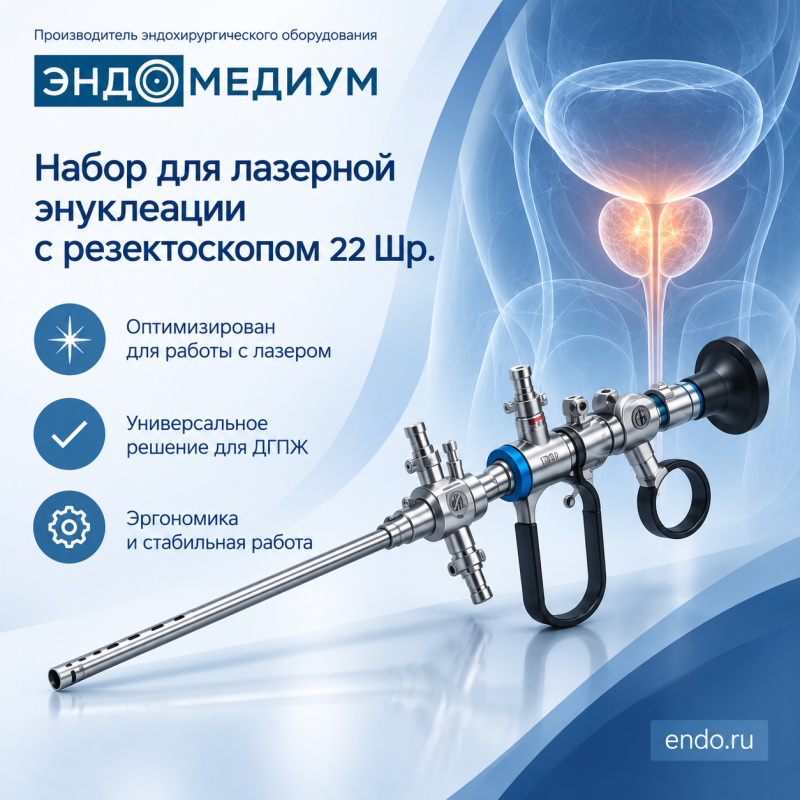
Laser Enucleation Set with resectoscope 22 Fr
Laser Enucleation Set EndoUro® The main clinical application of the kit is the pre-prostate gland, which is a good-quality hyperplasia — laser enucleation of the adenomatotic tissue of prostate under permanent endoscopic control, including HoLEP and TuLEP.
For laser enucleation phase laser resectoscope with external tubus 26 Fr Additional set normal resectoscope with external tubus 22 Fr, This allows the system to be used for different stages of transurethral endoscopy intervention depending on the surgical equipment selected.
Clinical use in sound prostate hyperplasia
The main application of the recruitment is surgical treatment sound prostate hyperplasia (jPW, BPH), with infrared obstruction and prompt treatment.
Laser enucleation is based on the anatomical separation of the hyperplased prostate tissue from the surgical capsule. The endoscopy surgeon is responsible for the sequence of the enucleation plane, separating the adenomatotic nodes and moving them into the bladder cavity for subsequent removal.
This principle is used in modern endoscopy enucleation techniques for prostate, including HoLEP, TuLEP and other options for laser treatment of the GWP.
HoLEP is a prostate golm laser enucleation
One of the main options for clinical application of the system is HoLEP — Holmium Laser Enucleation of the Prostate. This method uses golmium laser energy to separate hyperplased tissue along the natural anatomy layer between the adenoma and the surgical pod of the prostate gland.
Under direct endoscopy control, the surgeon determines anatomic orientations, forms an enucleation plane and separates the shares of the adenomatotic tissue in sequence. Once enucleation is completed, the separated tissue is moved into the bladder and then removed during the next intervention phase.
TuLEP and other laser enucleation options
The kit can be used in endoscopy laser enucleation procedures with compatible laser surgical systems. In addition to HoLEP, global endourological practices use techniques using tuli laser energy, including ThuLEP and other anatomical enucleation options.
The principle of intervention is common: the surgeon, under visual control, separates hyperplasired tissue from the surgical capsule, while using laser energy to dissect tissue and hemostasis.
Anatomical enucleation of prostate tissue
Unlike a layer resection where tissue is removed by separate fragments, anatomical enucleation is aimed at forming a natural surgical plane between the hyperplazeous tissue and the prostate capsule.
Once the right layer is determined, the surgeon can progressively separate large fragments or shares of adenomatotic tissue. This approach is the basis for modern endoscopy enucleation techniques presented in the clinical decisions of CARL STORZ, Olympus, Richard Wolf, RZ Medizintechnik and other world endourological equipment manufacturers.
Encletion of large adenomatotic nodes
The laser enucleation method is oriented towards the anatomical separation of hyperplaze tissue, which allows large fragments or whole parts of the adenoma to be formed and then moved into the bladder.
This principle is particularly important in the case of hyperplasia, where the surgical task is not only to form a canal in a simple urethra, but also to remove a large amount of adenomatotic tissue.
The exact scope of intervention, the enucleation technique and the surgical tactics are determined by the doctor depending on prostate anatomy, clinical situation and laser system used.
Laser enucleation and hemostasis
Laser energy during enucleation is used not only to separate tissues but also to control bleeding areas of the operating field. Permanent endoscopy visualization allows the doctor to assess the condition of the surgical capsule and perform additional haemostasis as he moves along the enucleation plane.
The possibility of combining tissue dissection and hemostatic effects is an important part of modern laser surgery of the DWP and is taken into account in the systems of world-wide leading producers.
Transurethral endoscopy access
The laser enucleation is performed by transurethral access through natural urine routes and the Endoscopic system is conducted through a urinary duct to the prostate region, allowing the main stages of intervention to be performed without surgical access through the front abdomen wall.
During surgery, the surgeon visualises the anatomic orientations of the simple urethra, seed urethra, external sphincter area, hyperplazed lobes and surgical capsule.
Two diameters resectoscope Tubuses — 22 and 26 Fr
The recruitment combines two options resectoscope For laser enucleation of prostate glands laser resectoscope with external tubus 26 Fr, designed to conduct laser instrument and endoscopy enucleation phases under visual control.
Additional used normal resectoscope with external tubus 22 Fr, which can be used for other transurethral endoscopy manipulations in surgical treatment of a sound prostate hyperplasia.
Two types of dimensions — 22 and 26 Fr — Increases the ability to use the set at different stages of endoscopy intervention and allows choice of resectoscope The system is based on the specific clinical task and surgical equipment used.
Various enucleation techniques
Laser enucleation can be performed by various surgical techniques, and the world practice is classical tridal and two-done enucleation, as well as options en bloc, where the surgeon seeks to form a single anatomical plane of the removal of the adenomatotic tissue in sequence.
The choice of the particular technique depends on prostate anatomy, the volume of hyperplased tissue, the laser used and the surgeon's preferences.
Laser enucleation and subsequent removal of tissue
After the removal of the adenomatotic tissue, the enucleated fragments are usually moved into the bladder.
Modern endourology uses morphography, a mechanical shredding of tissue in the bladder cavity, followed by the evacuation of fragments, which is a logical extension of laser enucleation and is used in clinical systems of CARL STORZ, Olimpus, Richard Wolf, RZ Medizintechnik and other manufacturers.
Main clinical challenges
Laser Enucleation Set EndoUro® may be used in transurethral endoscopy interventions related to:
- Surgery treatment of a sound prostate hyperplasia;
- laser enucleation of the adenomatotic tissue of prostate;
- in implementation of HoLEP;
- Implementation of ThuLEP and other compatible laser enucleation techniques;
- formation of an anatomical plane between hyperplazed tissue and the surgical capsule;
- Endoscopy separation of adenomatotic tissue shares and fragments;
- Surgery guidelines under direct visualization;
- by laser dissecting tissue;
- Endoscopy Hemostasis Control;
- moving enulled tissue into the bladder for subsequent removal;
- to carry out additional transurethral endoscopic phases using resectoscope systems 22 Fr
EndoUro® for modern DWP surgery
Laser Enucleation Set EndoUro® The main clinical application is anatomic laser enucleation of the hyperplazeous prostate tissue under constant endoscopy control.
For laser enucleation phase resectoscope External Tubus system 26 Fr, a additional resectoscope with external tubus 22 Fr Allows for other endoscopy stages of intervention in the selected surgical tactics.
The system may be used in the HoLEP, TuLEP and other compatible laser enucleation systems, which include separating the adenomatotic tissue from the surgical capsule and then removing the enulled tissue.
The specific readings and counter-intelligences used, the enucleation technique used, the type and parameters of laser energy, the manner of removing the enulled tissue and the compatibility with the additional equipment are determined by the registration and operational documentation of the relevant medical products.
| 1 |  | арт. 6000-21C, Cystoscopy 4 mm 12° EndoGlance® Cystoscopy, high resolution, diameter 4 mm, angle of vision 12°, length 302 mm, Wideform, auto-cloved, adapted to the FULL HD video systems and 4К, Series EndoGlance®. Number: 1 unit |
| 2 |  | арт. 4510-11, external Tow resectoscope 26 Fr External Tubus resectoscope 26 Fr, turning, working length 180 mm; Two Luer shut-off cranes, simultaneous delivery and discharge of liquid, fixation of LOCK. Number: 1 unit |
| 3 |  | арт. 4510-13, internal laser tube resectoscope 26 Fr Internal tube for laser resectoscope 26 Fr, turning point, metal tip Number: 1 unit |
| 4 |  | арт. 4510-21, internal Tubus Tubus Tubus Tubuser 26 Fr Internal Tubus Tubus Tuber resectoscope 26 Fr, intended to close its distal end during the introduction phase; working length 230 mm, Diameter of the dystals 7 mm. Number: 1 unit |
| 5 |  | арт. 4500-51, optimal EsHGI Tutor to resectoscope EndoUro® and hysteroresectoscope EndoGyne® 26 Fr ESHGI optical tourator for resectoscope systems 26 Fr, under optical Ø4 mm. Number: 1 unit |
| 6 |  | арт. 4500-54, optional SCHMIEDT Tuerator with channel to resectoscope 26 Fr EndoUro® SCHMIEDT optical tugboat with channel 5 Fr for resectoscope systems 26 Fr, under optical Ø4 mm; working length 230 mm, Diameter of the dystals 7 mm. Number: 1 unit |
| 7 |  | арт. 4510-05, working element laser EndoUro® Lazer Working element of laser resectoscope, Laser probe channel, external tubus 26 Fr compatible with endoscopy diameter 4 mm. LOCK Locking System». Number: 1 unit |
| 8 |  | арт. 6000-26C, Cystoscopy 2.7 mm 12° EndoGlance® Cystoscopy, high resolution, diameter 2.7 mm, angle of vision 12°, length 302 mm, Wideform, auto-cloved, adapted to the FULL HD video systems and 4К, Series EndoGlance®. Number: 1 unit |
| 9 |  | арт. 4510-15, external Tow resectoscope 22 Fr External Tubus resectoscope 22 Fr, turning, working length 180 mm; Two Luer shut-off cranes, simultaneous delivery and discharge of liquid, fixation of LOCK. Number: 1 unit |
| 10 |  | арт. 4510-16, internal tube resectoscope 22 Fr Internal Tubus resectoscope 22 Fr, bend, thermo-resistant ceramic tip and by-net fixed to the working element; overall length 237 mm. Number: 1 unit |
| 11 |  | арт. 4510-23, internal Tubus Tubus Tubus Tubuser 22 Fr Internal Tubus Tubus Tuber resectoscope 22 Fr, intended to close its distal end during the introduction phase. Number: 1 unit |
| 12 |  | арт. 4500-52, optimal EsHGI Tutor to resectoscope EndoUro® and hysteroresectoscope EndoGyne® 22 Fr ESHGI optical tourator for resectoscope systems 22 Fr, under optical Ø2.7 mm. Number: 1 unit |
| 13 |  | арт. 4510-04, working element EndoUro® and EndoGyne® 22 fr mono-bipolar active Working element resectoscope, for external tubus 22 Fr, monopolar and bipolar mode of operation, active cutting, compatible with endoscopy diameter 2.7 mm. Number: 1 unit |
| 14 |  | арт. 1510-27, Electrical resectoscope the bead is corner 30° 22 Fr HF electrode mono-bipolar 20 Fr for hybrids hysteroresectoscope and resectoscope 22 Fr, shape of active part of the Hinge 30°. Number: 1 unit |
| 15 |  | арт. 1510-34, Electrical resectoscope Scar 22 Fr HF electrode mono-bipolar 20 Fr for hybrids hysteroresectoscope and resectoscope 22 Fr, form of active part of the Shar. Number: 1 unit |
| 16 |  | арт. K501-21, bipolar electro-surgery cable for hybrids resectoscope Electrical surgical cable for hybrids resectoscope EndoUro® and hysteroresectoscope EndoGyne®, Open bar hardware 4 mm. Number: 1 unit |
| 17 |  | арт. 4510-20, tubus tubus outside 26 Fr Outside Tubus Tubus Tuber resectoscope 26 Fr, intended to close its distal end during the introduction phase. Number: 1 unit |
| 18 |  | арт. 6010-01, Morcescope EndoGlance® 26 Fr 0°C Toolbox Morcescope EndoGlance®, Tubus diameter 26 Fr, angle of vision 0°, Direct tool 4.6 mm, Workspace length 180 mm Number: 1 unit |
| 19 |  | арт. 1037-01, canula Luer Kanulia Luer, total length 26 mm; Lover rotating connector 6 mm. Number: 1 unit |
| 20 |  | арт. 1037-02, Canyul "Louir" with crane Canyul "Louir" Crane, total length 42 mm; lover rotating connector 6.5 mm. Number: 1 unit |
| 21 |  | арт. 5021-31, the basket EndoGBox® 460х150х80 Cleaning, sterilization and storage basket, universal, size 460 × 150 × 80 mm Number: 1 unit |
| 22 |  | арт. 6111-111, light cable, length 2,5 m Whole-line endoscopy light-driving, autoclavic, straight-lined, for endoscopys with diameter prior to 5 mm, length 250 cm, Protective optical glazing, high light transmission. Number: 1 unit |
| 23 |  | арт. 1035-06, the brush is flexible for cleaning the toolbox 3 mm Internal surgical instrument channel brush, for canals of diameter 2.5–4 mm, length 400 mm, flexible handle for bent channels Number: 1 unit |
| 24 |  | арт. 1035-07, the brush is flexible for cleaning the toolbox 5 mm Internal surgical instrument channel brush, for canals of diameter 4–6 mm, length 400 mm, flexible workspace, for bent channels Number: 1 unit |