
Low-preperature plasma absulation in artroscopy — Electrosurgery technology for soft tissue using a controlled bipolar radio frequency (RF) in the liquid conductive environment.
The technology is used for minor invasive joint interventions for the ablation and processing of soft tissue under direct arthroscopic control. Various forms of electrode work allow for the adaptation of the instrument to the joint anatomy and the location of the target tissue.
INGO Endomedium developed a line of bipolar arthroposcopy absulators EndoArtro®, for joint work with the Electrical Surgery System WizardCut®.
What is a low temperature plasma absulation?
In bipolar RF-electrical operation, electrical energy affects the liquid media in the immediate vicinity of the active part of the instrument.
This principle is different from mechanical removal of tissue shaver and from traditional electrosurgery effects: the work effects are localized in the active part of the electrode and controlled by the surgeon under endoscopy visualization.
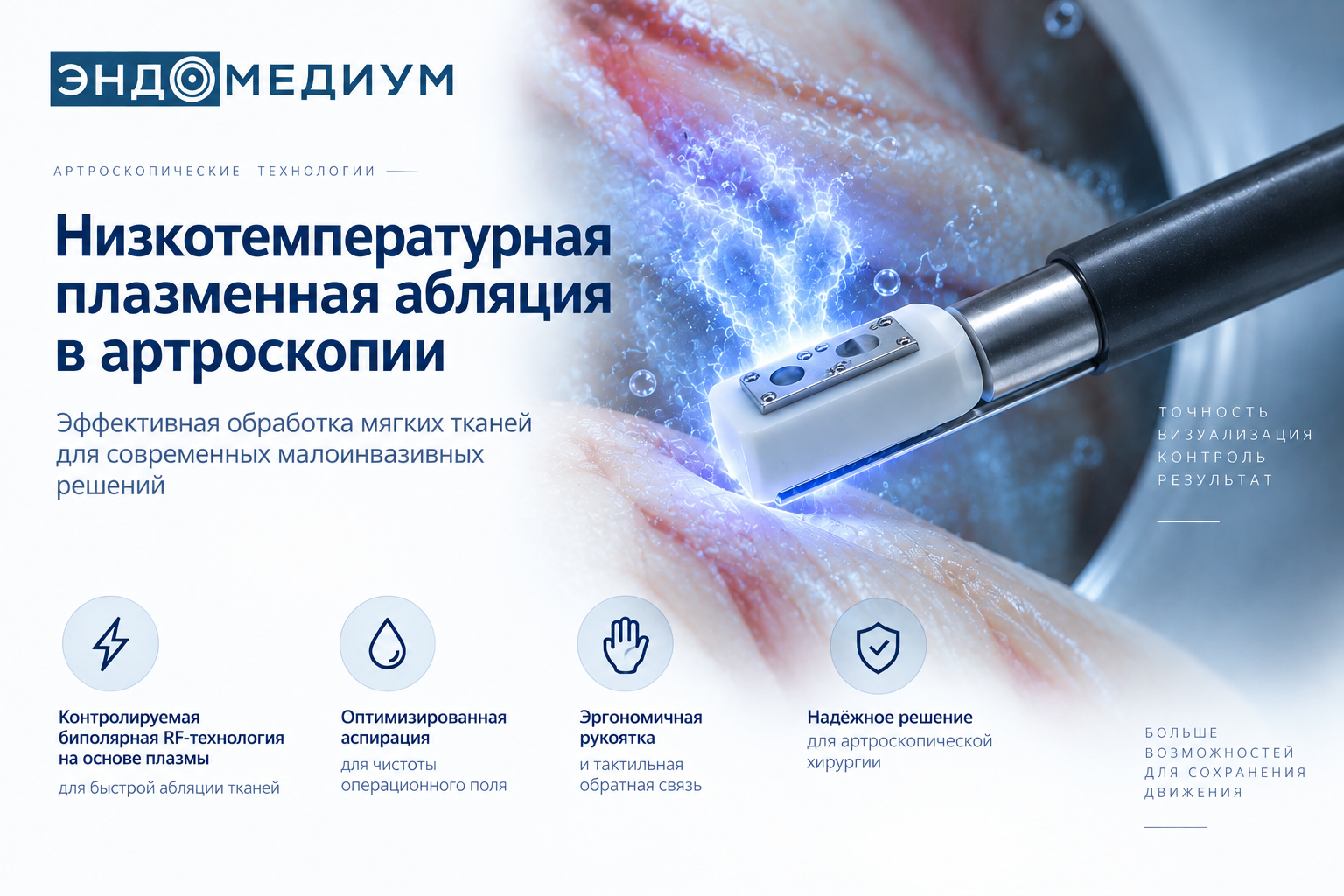
How the bipolar arthroplex absulator works?
Interference EndoArtro® used controlled bipolar radio frequency technology based on plasma, designed for rapid ablation of tissue.
Electrical Surgery System WizardCut® Forms for abulators EndoArtro® optimized radio frequency wave form for effective tissue absulation.
Exposure occurs directly in the electrode work area. Surgeon controls instrument position and endoscopy effects.
| Component | Function |
|---|---|
| WizardCut® | Formation of optimized radio frequency form |
| EndoArtro® ablation probe | Supply of bipolar RF power directly to the work area |
| Active part of the electrode | Formation of the plasma working area |
| Aspiration channel* | Evacuation of liquid and particulates from exposure |
| Endoscopic video system | Visual control of surgical interventions |
* Selected models EndoArtro®.
What uses plasma absulation in artroscopy?
Radiofrequency technologies are used in artroscopic surgery to process soft tissue and a number of debride procedures. The specific task depends on the anatomical area, the nature of the pathology, the surgical technique chosen and the configuration of the working electrode.
The scientific literature of RF technologies deals, inter alia, with artroscopic treatment of soft tissue and cartilage lesions.
The knee joint
RF instruments can be used for artroscopic knee interventions to treat soft tissue and selected artroscopic debride options.
The joint
The various radiometry of RF electrodes allows operation in the limited shoulder joint space and directs the active surface relative to the tissue being processed.
Butt joint
Access to anatomicalally complex sites is particularly important for hip arthroscopy. The bends and cornered working parts allow the active electrode to be reoriented relative to the target area.
For the Oval Abulator EndoArtro® The manufacturer is required to use the hip, shoulder, knee, ankle and elbow joints in artroscopy operations.
Artroscopy Absulators EndoArtro®
Line EndoArtro® The configuration is designed to adapt the tool to the anatomical area, access direction and the nature of the surgical task.
- EndoArtro® Circle ablation probe — ringwork, bipolar regime, aspiration channel.
- EndoArtro® Circle 2 ablation probe — Workspace 2, Bipolar regime, aspiration channel.
- EndoArtro® articulating Circle ablation probe — bendable workspace to change electrode orientation relative to target area.
- EndoArtro® Oval ablation probe — oval work, bipolar regime, aspiration channel.
- EndoArtro® Plat ablation probe — flat workspace, bipolar regime, no aspiration channel.
- EndoArtro® Hook ablation probe, 20° — hooked workspace with bend 20°, Bipolar regime, without aspiration channel.
All models are part of the Artroscopic RF instrument line EndoArtro®. You can select a suitable configuration in the section Artroscopy Absulators EndoArtro® .
Why is the shape of the operating part of the abbreviator relevant?
In arthropscopy surgery, access to target tissue is limited by the diameter of the instrument channel, the anatomy of the joint and the direction of application of the instrument.
Line EndoArtro® includes seven work-part configurations: Circle, Circle 2, Circle bend, Oval, Oval 2, Plat and Hook 20°.
| EndoArtro® | Geometry | Aspiration | Design specificity |
|---|---|---|---|
| Circle | Ring | Yes | Circle Workground |
| Circle 2 | Ring | Yes | Circle configuration 2 |
| Circle bent | Changed | — | Orientation of active part of the relatively difficult area |
| Oval | Oval | Yes | Oval work surface |
| Oval 2 | Oval | Yes | Oval configuration 2 |
| Plat | Flat | None | Broad flat work surface |
| Hook 20° | Hook-shaped, 20° | None | Corner access to target tissue |
Watch Artroscopic Absulators EndoArtro®
Plasma abbbulation aspiration
During exposure, tissue particles and processing products may be present in the operating fluid that may impair the visualization of the work area.
Models EndoArtro® With aspiration channel optimized aspiration ensures effective particle evacuation directly from the field of exposure, helping to maintain the visualization of the operating field.
Aspiration canal is provided in models Circle, Circle 2, Oval and Oval 2.
Argonomics of the artroscopic abulator
In artroscopy, the surgeon controls the working part of the tool in limited space and constantly controls its position in endoscopic representation.
Ergonomic handle of the abbreviators EndoArtro® Provides Tactile feedback in manipulation of the instrument, helping the surgeon to control the active part.
Plasma abblation and shaver: What's the difference?
| Characteristics | Plasma RF Abulator | Artroscopy shaver |
|---|---|---|
| Principle | Bipolar plasma-based radio frequency exposure | Mechanical rotation/occillation |
| Working tool | RF electric | Rotating or oscillating freze/raze |
| Principal challenge | Absorbation and electro-surgery of tissue | Mechanical resection and removal of tissue |
| Particle evacuation | In-line aspiration in selected electrodes | Aspiration via shaver tool |
These technologies are not necessarily alternatives to each other: depending on the surgical task of the RF-abulator and shaver may perform different functions within a single artroscopy intervention.
What scientific literature says about radio frequency absulation?
Radiofrequency technologies in arthroscopy have been under investigation for many years. Experimental work confirms the possibility of plasma-intermediated bipolar RF effects on tissue, while also showing that biological effects depend on the effects parameters.
Enochson and Soavt study the effects of plasma-mediad bipolar radiofrequeccy ablation on human hondrocytes and demonstrated the localized area of direct cellular post-effect death.
A systematic review of clinical results of the radio-frequency knee joint hondroplastics showed favourable clinical results in published studies, but authors also draw attention to the need to further study long-term results.
Temperature at RF-abulation: Why Irrigation and Control are important?
The term "low-temperature plasma absulation" should not be understood as a total absence of thermal effects.
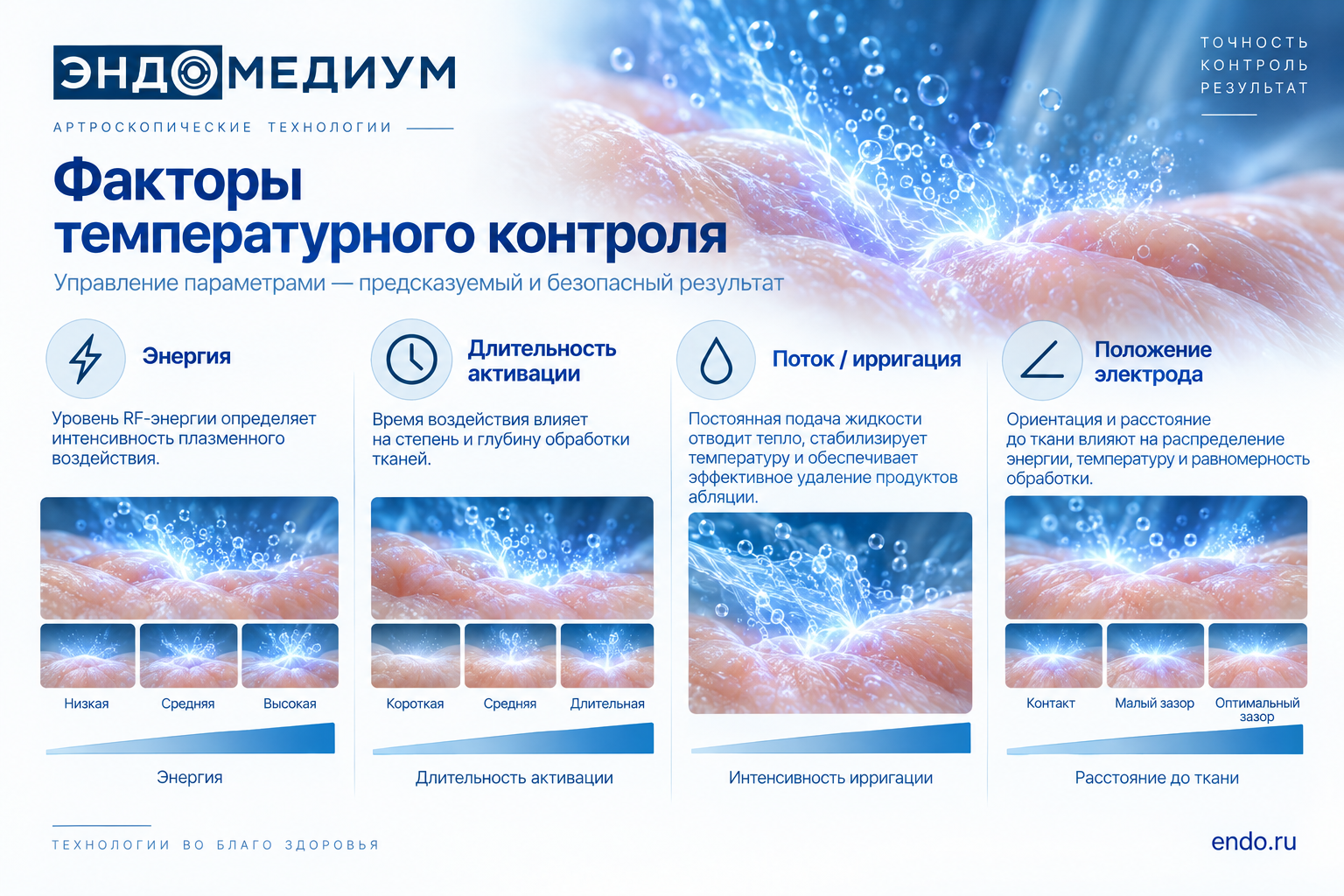
Research shows that when using RF tools, the temperature in the joint depends on the capacity, duration of activation, distance to tissue, volume and temperature of the irrigation fluid, and the rate of circulation of the fluid.
Therefore, for arthropscopic RF-abulation, compliance with manufacturer ' s instructions, adequate irrigation, visual control of the work area and correct selection of electrosurgery parameters are important.
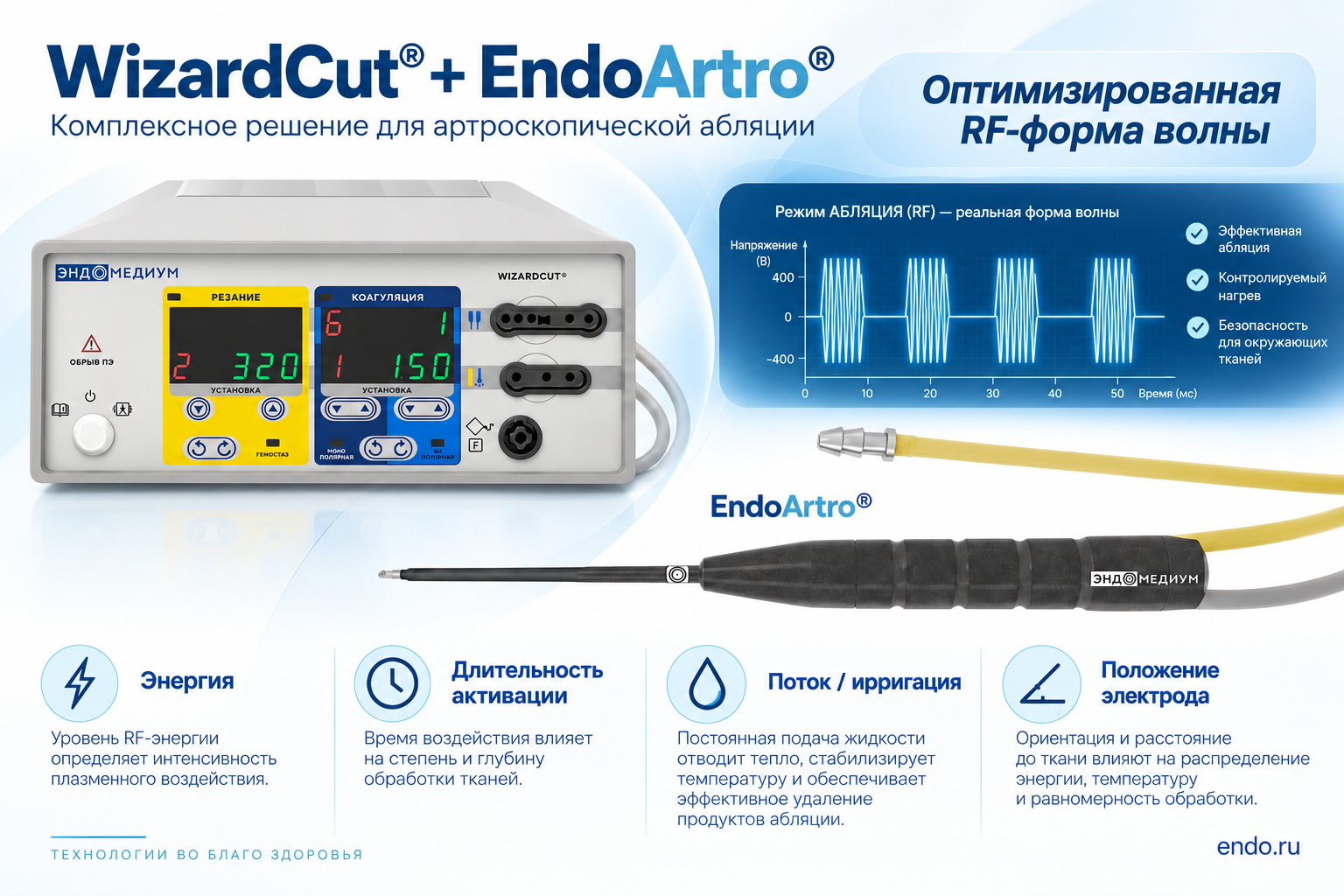
EndoArtro® and WizardCut®: Single electric surgery system
Interference EndoArtro® to work together with the Electrical Surgery System WizardCut® INGO Endomedium.
WizardCut® shapes for EndoArtro® Optimized radio frequency wave form designed for effective tissue absulation.
The generator + abulator system allows for the consolidation of the RF power source and the specialized arthropscopic instrument in the arthropcopy operating equipment complex.
Russian-made equipment for arthroscopy
INGO Endomedium The integrated equipment of the arthropscopic operating system may include endoscopic visualization systems, arthroposcopy, pumppoo, shaver system, electrical surgical equipment and specialized surgical tools.
More detailed: Artroscopic instruments | Artroscopy EndoGlance® | shaver systems | EndoArtro® ablation probes.
Frequent questions about plasma absulation in artroscopy
What a plasma absulator is?
Plasma Arthroscopy Abulator is an electrosurgery tool that uses bipolar radiofrequency energy to form a working plasma zone in a liquid environment and to influence soft tissue.
The difference between plasma absulator and shaver?
Shaver The RF battery uses electro-surgery radio frequency exposure. In the arthropscopic operating room, both technologies can complement each other.
Which joints are subject to artroscopic absulation?
RF technologies are used for artroscopic interventions at different joints. Specific application is determined by the purpose of the selected medical product and the surgical task EndoArtro® provided for in hip, shoulder, knee, ankle and elbow operations.
What's the reason for the ablution?
The aspiration tunnel allows the removal of liquid and particles directly from the work area, which contributes to the preservation of visual control of the operating field.
Which electrosurgery machine does the abulators work with EndoArtro®?
Interference EndoArtro® used in conjunction with Electrical Surgery System WizardCut®.
Scientific publications
- Enochson L. et al. Bipolar radiofrequency plasma ablation induces proliferation and alters cytokine expression in human articular cartilage chondrocytes. Arthroscopy. 2012.
- McCormick F. et al. Effect of radiofrequency use on hip arthroscopy irrigation fluid temperature. Arthroscopy. 2013;29(2):336–342.
- Huber M. et al. Temperature profile of radiofrequency probe application in wrist arthroscopy. 2013.
- Lin C. et al. The arthroscopic application of radiofrequency in treatment of articular cartilage lesions. 2022.
- Tuthill T. et al. Radiofrequency chondroplasty of the knee: systematic review of clinical outcomes and complications. 2023.
The material is intended for health professionals. Specific statements, working conditions, restrictions and procedures for the use of medical products are determined by the manufacturer ' s registration and operational documentation.