Application: 2000111651/14, 2000.05.10
Date of commencement of report of patent validity: 2000.05.10
Date of application: 2000.05.10
Published: 2002.08.20
Authors: Sparrows by K.I. (RU)
Patent holders: Society with limited liability Endomedium+" (RU)
Documents cited in the search report:
CARL STORZ catalogue "KARL STORZ ENDOSKOPE".
12-93.TROC 17.30.107WZ. SU 1445713 A1, 23.12.1988.
SU 1232236 A1, 23.05.1986. DE 2528738 A1, 12.05.1977.
Reference: RU2187266C2_20020820.pdf
Abstract
Invention is a medical tool and a surgical tool that allows entry into or into the body endoscopic surgical Operation monitoring operations for diagnostics. TRoacar The spring is located in space between the circular elements. The spring wing is compensatory and is located on the axis. The flexible end of the spring shoulder is radiused and the pusher is pressed. The other spring shoulder also has radius curve and the closing curve interacts with the pusher ' s accent. The pusher is fitted with a button and is connected with the axis of the rotor console and fixed on the axis of the ring cell 45-50o. As a result, such constructive performance ensures simplicity, reliability, completely excludes end-of-line or side damage to the telescope, ensures guaranteed sterilization and is fully approved by surgeons in testing operations. 3 IL.
Pictures
Formula of invention
Troacar, containing a shell casing and a demountable valve mechanism with a pusher and a ripple-tightening device, different from that containing a hinged spring between the circular elements, the hinge being compensatory and located on the axle, with the fork end of the spring shoulder having a radius curve covering the pusher and pressing the seal, and another spring shoulder having a radius curve also having a radius curve, fixing the bending effect with the pusher ' s focus, the end of which is connected to the axis of the ring, with the pusher connected to the axis of the ring cell, with an ally-shaped self-indicated ellipse enserting the ellipse surface of the cosmic cut valve attached to the console.Description
Invention is a medically-like and surgical tool that allows entry into the body at the time of the birth of the child endoscopic surgical Operation monitoring or diagnosis operations.
Known Troacar (Path. 2043076, BI 25, 10.09.95), containing a shell shell casing containing a valve mechanism in the form of two joints closely connected to the elastic mufta, one permanently connected to the shell of the casing and the other with a rotating muft with a turning point relative to the longitudinal axis, consisting of a adjusting screw with radial grooves on the neck neck and a stop ring with a pin to interact with the grooves springed with the shell of the shell. The Troacar is a complex design for a valve mechanism to be used by a surgeon during an operation that needs to be operated, rather than being able to turn, turn, adjust and stop the valve mechanism. In addition, an instrument with elastic mufta and its compounds is unreliable and difficult to sterilize. Troacar, according to the surgeons and our firm, was not used in practice.
Publicly known trocars ("STORZ" page.16.) with a commonly known sealing mechanism used in conjunction with Style in operational clinics.
The prototype is taken Troacar ("STORZ page.17) with a valve mechanism designed to operate both the styling and the symmetrical laparoscope, For example, for abdominal surgery (See annex. 3) contains the lever (1), at the bottom of which (See species "A-A") slit is available (2) under the head of the pusher (3) and closed rolling bar (4). Pusher (3) through seal (5) through the shell (6) and is trapped in a fixed axis (7) with multi-twig cylindrical spring (8) Folding cover (9) Sealing gasket (10) and rigidly fixed reflecting bulging surface (11). The edge of the valve is straight, perpendicular to the longitudinal axis of the troakar (12) Troakara corpses with beans (13) of the valve unit.
The valve mechanism can operate manually and automatically (1) with a bar (4) fixed to the pusher (3), with which the lid is opened (9) and its retention in the open position while holding the lever (1) "Push." When the lever is released (1) It all goes back to the original position and the lid (9) with gasket (10) Shut the opening (Channel) Troakara.
In automatic mode, lever (1) with a bar (4) unset from the pusher (3). Opening of the cover (9) is implemented by a tool introduced into the troacar, e.g. end end Telescopes, and when the telescope is removed from the troakar by spring spring (8) Cover (9) Closed. On re-entry Telescopes It's all happening again.
One of the shortcomings of the prototype troakar is the large overall lever and the self-displacement of the detachment connection. Another disadvantage is the presence of three springs: two cylindrical multi-tipedes located in hard-to-reach surfaces on the edge of the lever axis to return the lever to its original position (Up) The presence of the spring reduces the reliability of the instrument, the multi-pile spring on the valve lid after a series of re-uses in operations and subsequent sterilizations have been blocked and stopped working, which required the dismantling of the instrument and the replacement of the spring, but its failure may occur during the operation.
However, the more significant disadvantage is that when the valve lid is opened, the spring is rolled and the input force on the telescope is increasing more than the opening of the valve lid, which by its internal convex surface affects the lateral surface of the input or manufactureable telescope and does not preclude damage to its insulating coating.
The presence of an increasing and sufficiently large force when opening the valve lid and its perpendicular position relative to the axis of the troakar is the main defect in the tool because, when the telescope is in the introduction or removal process, it causes failure. For example, in automatic operation when the telescope is introduced, it acts with the glass of its end (It's pushing) The convex surface of the valve lid is sufficiently convexed and, having overcome the considerable rectangular resistance and increasing spring resistance when the lid is opened, the glass pane of the telescope is scratched and rendered unserviceable.
The manual valve lid control has proved that these deficiencies cannot be avoided. The surgeon either fails to press the lid opening lever or releases it early, and then bulges the valve lid surface and often breaks it, which the surgeon complains to the designers and asks for a solution without these deficiencies.
Proposed Troacar Suitable to surgeons and lacking all the defects of the prototype.
The proposed invention is expressed in the following set of features that are significant and that make it convenient for a surgeon to operate a troachar with the possibility of using a manual or automatic valve mode, ensuring the reliability of the troakar multiple operation, the safety of glass and the side insulation of the telescope, ensuring the guaranteed sterilization of the instrument and the reliability of the valve connection with the troakar body, which completely excludes self-distribution.
This is achieved by the proposed triacar containing a shell casing casing and a removable valve machine containing only one hinged spring located between the circular elements, the hinge of which is compensatory and located on the axis, with the fork end of the spring shoulder having a radius curve, covering the pusher ' s bolt and pressing the seal of the pusher, and the other spring ' s shoulder having a radius curve also having a radius of bending effect, the movement of the pusher ' s focus, the tip of the pusher being fitted with a button and the axis being connected to the axis of the spring, the axis of the spring ' s axis being secured to the console by the self-directive ellipse leptation of the ellips form, which is sealed with the ellipsal surface of the valve.
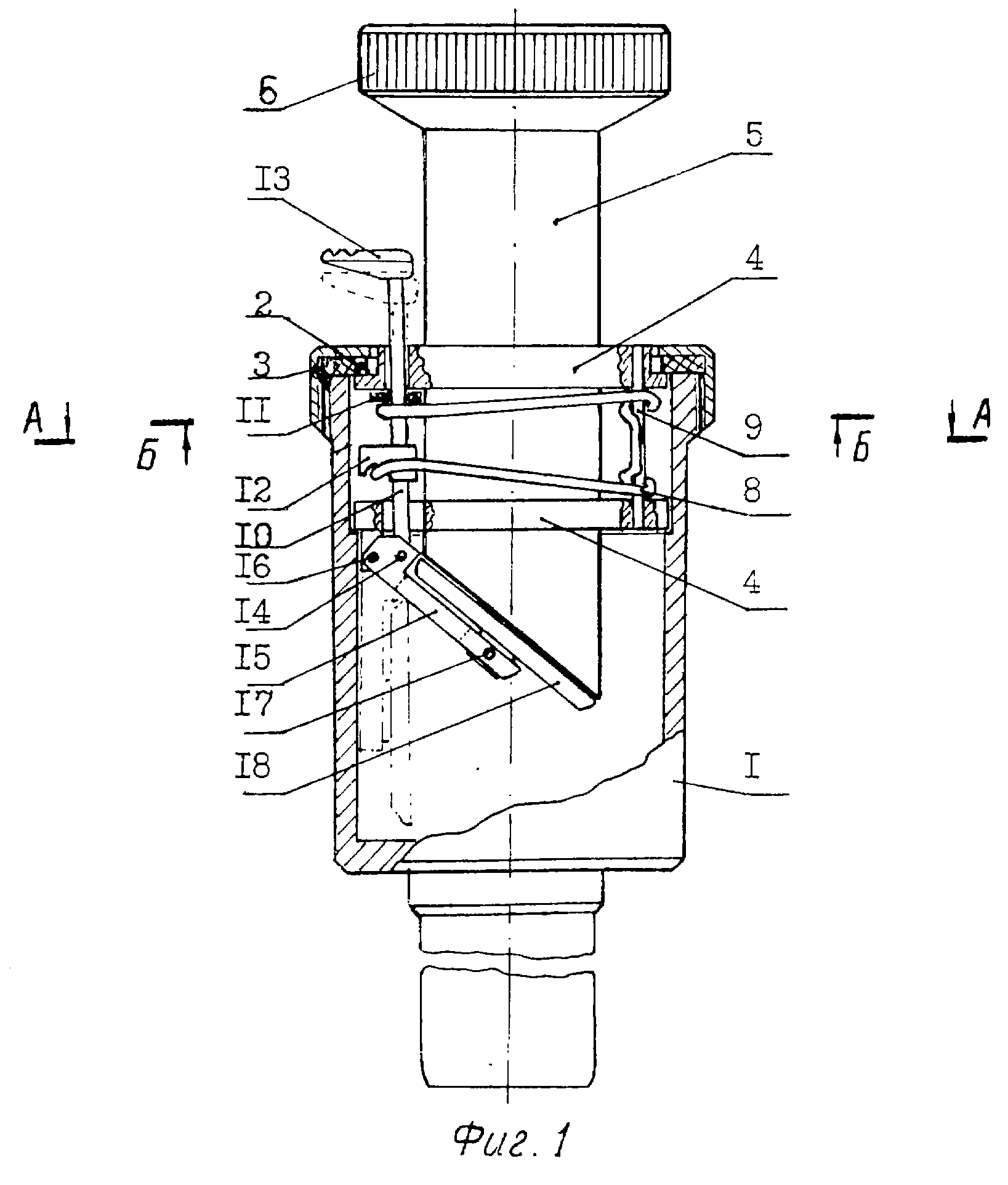
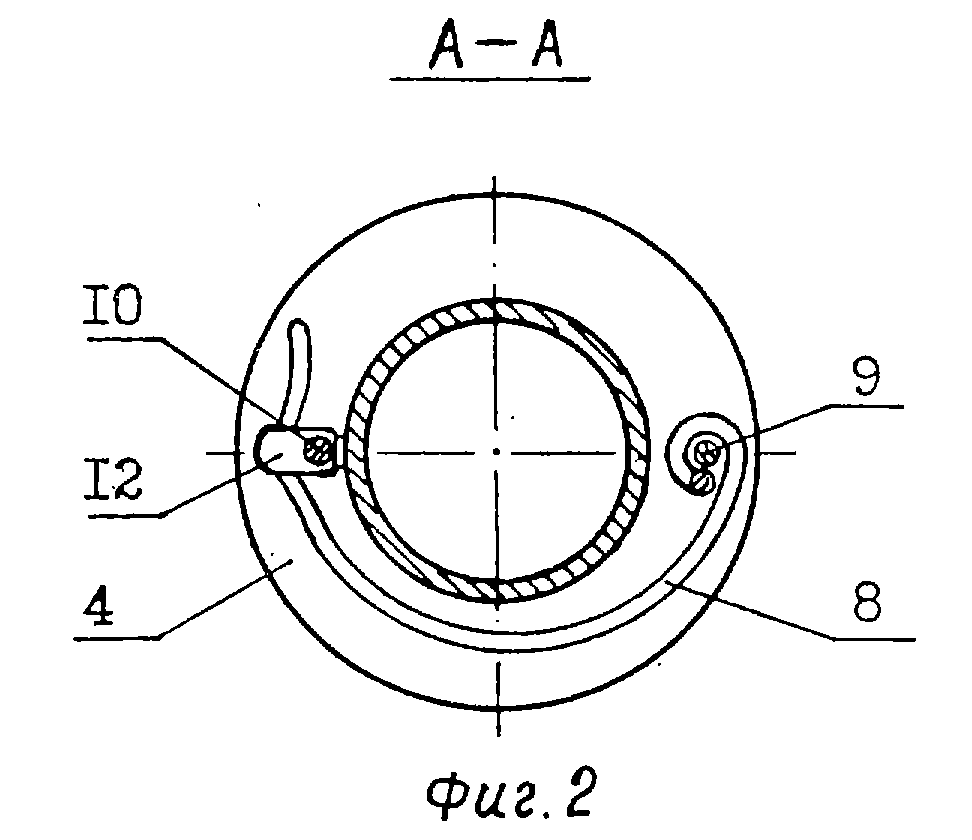
Fig. 1 shows the trocar and valve mechanism in the closed position, with dashed lines indicating the open position. Fig. 2 shows view А–А of the spring arm that engages the pivot and the actuator stop.
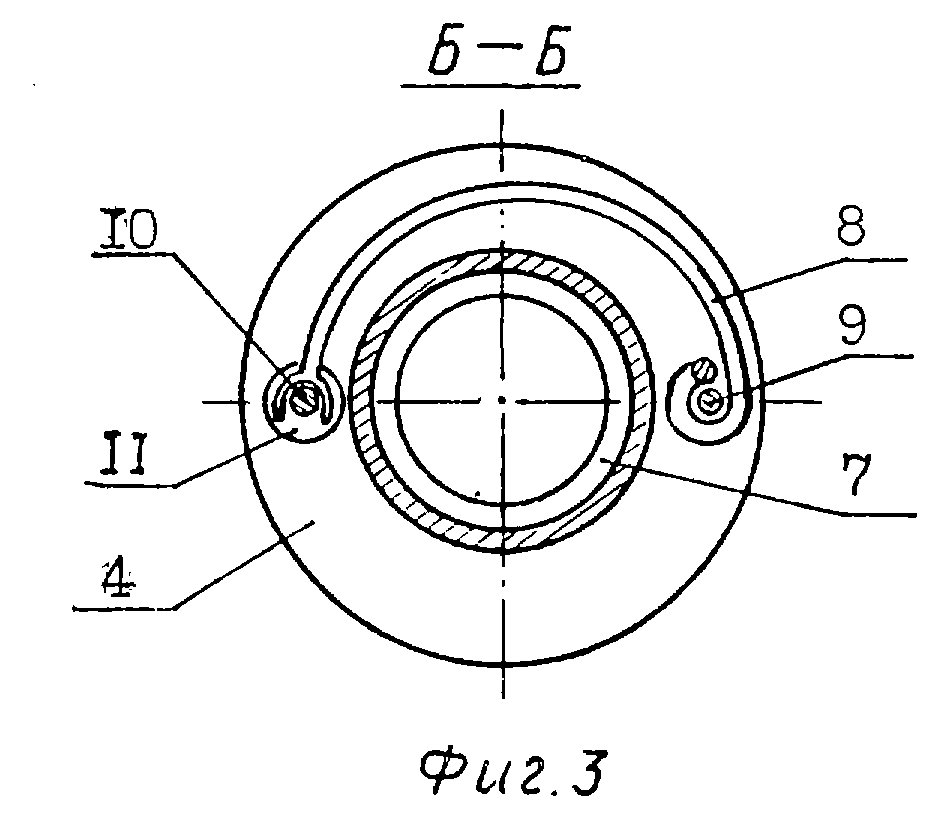
Fig. 3 shows view Б–Б of the spring arm, which connects through a fork to the actuator seal and to the pivot.
In Figs. 1–3, a removable valve mechanism sits on a shoulder in the upper portion of the trocar body (1) and is located by the internal diameter of the body (1). A gasket (3) and a retaining nut (3) with a ribbed outer surface seal the assembly and allow rapid removal and secure installation. The valve mechanism comprises two rings (4) on a cylindrical section (5), with a neck (6) and an internal seal (7) for the telescope inserted through the trocar. A single loop spring (8) has a compensating loop mounted between the rings (4) on pin (9). The forked end of one arm of spring (8) straddles the actuator rod (10), which passes through the rings (4), and presses against actuator seal (11). A retaining bend in the other arm of spring (8) engages stop (12) on actuator (10). Both arms of spring (8) are curved and lie between the rings (4). At one end the actuator (10) carries a button (10). At the other, pin (14) connects the actuator to arm (15), which is pivoted on pin (16) on one of the rings (4). Pin (17) on arm (15) carries a self-aligning elliptical flap (18) that seals the matching elliptical valve seat. If the valve is cut perpendicular to its axis, the seat and flap (18) are circular. The oblique valve cut is 45–50o.
The proposed valve-operated troacher is used as follows (6) with sealer (7) In the Troacar, the edge of the end of the telescope, namely the edge, not the glass of the end, is touching the petal (18), which is at the corner of the telescope and is influenced by the petals (18), It takes it away with the least force, because the console (15), The pusher pulls back (10) with focus (12) And he's pulling the lower shoulder of the spring (8), having a radius curve with sufficient length and compensation loop, which provides the necessary and diminishing force necessary for the full opening of the petal (18). The location of the axles (14) and (16) on one line when the pushed person is in the original position (10) and consoles (15) Also contributes to the soft removal of the petal (18). When the telescope is removed, petals (10) soft" also returns to the initial position and the angular position of the valve completely excludes contact of the petal (18) With the glass on the end of the telescope.
Manual mode by pressing button (13) pushed (10), The remover of the console (15) and petals (18), on release of the button (13) Everything is back to square one.
Spring (8) on the axle (9) may be side-by-side and her shoulders cease to interact with the pusher elements (10), which allows the curve to change the force of each spring shoulder (8) separately.
Such constructive performance ensures simplicity, reliability, completely excludes end-of-line or side damage to the telescope, ensures guaranteed sterilization and is fully approved by surgeons in testing operations.