Application: 94032692/14, 1994.09.08
Date of commencement of report of patent validity: 1998.03.20
Date of application: 1994.09.08
Published: 1998.03.20
Authors: P.G. Bugs.(RU), Lone V.V.(RU), A.E. Season.(RU), The Cyclones A.N. (RU)
Patent holders: Endo-Medium Scientific Production Company" (RU)
Documents cited in the search report:
1. STORZ THE WORLODOF ENDOSCOPV. 2/93, article. 109 - 111.
Reference: RU2106824C1_19980320.pdf
Abstract
The invention is designed to enter the body at the time of the invention endoscopic surgical Method of entry into the body during operations endoscopic surgical The operation by puncture and injecting the instrument requires that the first puncture and, if necessary, the subsequent simultaneous puncture and control the passage of the instrument through the tissue and its entry into the operating cavity Troacar, with a curling telescope of transparent material, e.g. org-glass, the tip may be removable if necessary. The method and instrument ensure the safety of the puncture of tissue under visual control and exclude injury to other organs. 2 c. and 1 C.E.P.L, 1 IL.
Pictures
Formula of invention
1. Method of entering the cavity at endoscopic surgical Operation involving the puncture of tissue and the insertion of instrument into the body, with the first puncture and subsequent puncture both puncture and control of the instrument through the tissue and its entry into the operating cavity.2. Instrument for entering the body at endoscopic surgical operations containing Troacar with a puncture, different from the pointing element being made by a telescope with a pricked tip of transparent material, e.g. orgstel.
3. Instrument on.2, different from the point that the pointer is made with the possibility of being re-sold.
Description
The invention is medical and is intended for use in the endoscopic surgical Operations.
A known way [1] Entering the cavity during endoscopic surgical Operation by punctured tissue with a special needle or troacar instrument. When a needle is punctured, the counter-resistance of the punctured tissue is small and this precludes a sharp failure of the instrument, and therefore damage to organs located in the cavity. In case of a puncture Troacar This risk increases, but various options have recently been created and patented, such as a troacar with a spring-sprayed protective element that, after punctured and re-entry, slides and covers the knife, prevents damage to other organs or tissues.
However, this is more difficult and cannot be considered safe because it provides for an initial puncture to perform a troacar in an uncontrolled but protected way with a sturator knife, then injecting into this puncture of the telescope, and then punctured with a narrow troacar with an unprotected knife, but under control already in place Telescopes.
The tool used, known from the same source, has many options for implementation, for example Igla Veresha or normal trocars and troachers with a protected knife and finally a narrow troacar with an unprotected knife, which is used under the control of a telescope already inserted through punctures performed by a protected knife troacar.
The essence of the invention is that the proposed way of entering the body and the tool for its implementation already allows for control, at the first puncture, not only of the position of the instrument in the body but also of the process of passing the punctured tissue and especially the initial stage of entry, which is particularly important when there are different spires or the relative position of other organs to the internal surface of the punctured tissue.
It's that the tool that punctures and enters the body is Troacar, whose pinging is made of transparent material, is reciprocally incorporated and can be replaced, allowing for simultaneous primary (As in the following) Punctures and monitoring of their performance when entering the body.
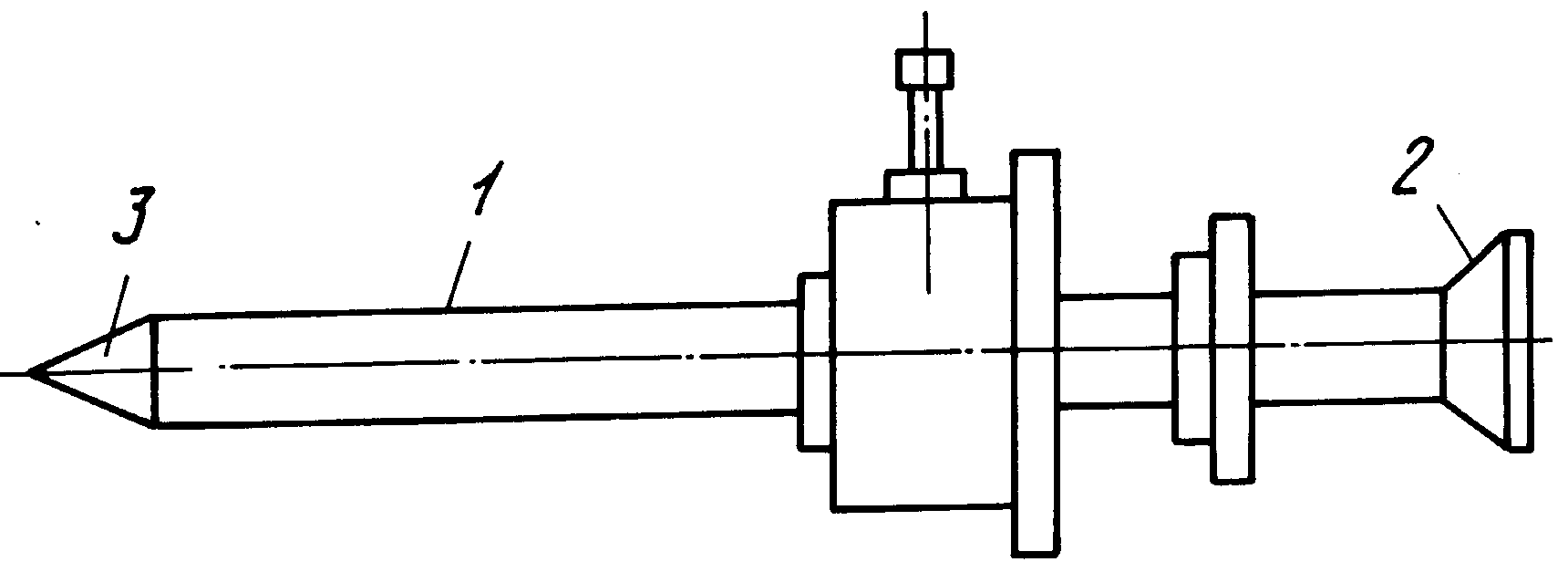
The drawing shows the general view of the tool.
The method is as follows.
For example, in an abdominal or thoracic operation at a specified point, the first puncture is made, while at the same time controlling the position of the Troakar knife when it comes out of the punctured tissue, entering it into the cavity and location in it. The first puncture may then be used to introduce operational tools or to monitor other punctures that may be performed in a known manner or, if necessary, each time proposed and, if necessary, with multi-position control of the re-entry process.
The tool is a troakard 1, containing a telescope 2 With a point-blinker 3 The puncture tip may be removed from the neck of the puncture and the pivot of the pivoted tip when the tissue is passed and the body is reached, with the exception of other organs.