Application: 95114723/14, 1995.08.16
Date of commencement of report of patent validity: 1999.04.27
Date of application: 1995.08.16
Published: 1999.04.27
Authors: I.M. Cheymurats. (RU)
Patent holders: Endo Media Scientific Production Company" (RU)
Documents cited in the search report:
1. Atlas of Endo cholecystectomy with auto suture instruments, K.A.Zucker, R.W.Bailey, 1992, 5 - 8.
2. Atlas of Endo Cholecystectomy, USA, 1992, p. 6, Fig. 6.
3. Aesculap catalogue, FRG, 1982, c.513, FF 22.
4. SU 202451 A, 14.09.67
Reference: RU2129402C1_19990427.pdf
Abstract
Inventions are medical, surgical, and can be used in endoscopic surgical Operation. Inject the human body with a locking device through the current puncture. One end of the device is attached to the internal organ. The fixed thread is removed from the outside at the other end. The thread is fixed with an emphasis on the skin surface of the patient ' s body. The method is to increase operational capability by reducing the injury of access. The instrument for locking organs or tissues is performed as a flexible metalonite or a line, one end of which is permanently connected to one working unit in the form, for example, of a flexible metal metal or wood, end clamp. The other end is provided with a removable and movable lock with a stop, which can change the tension of the thread and therefore the position of the fixed organ. 2 c. and 2 C.E.P.L, 1 IL.
Pictures
Formula of invention
1. Method of locking organs or tissues at endoscopic surgical Operation with locking devices, with one end of the fixture inserted through the current puncture, attached to the internal organ and a thread fixed to the other end of the device removed from the outside and fixed with an emphasis on the skin surface of the patient ' s body.2. Method in p.1, different from what the thread is brought out of the sky through the wall of the cavity.
3. Method in p.2, different from what the thread is derived by a long needle with an eye for the thread.
4. A body or fabric locker with working elements, different from that of flexible metalonity or a line, one end of which is permanently connected to one working unit, such as a closed clamp, and the other end with a movable and movable lock, with a stop-lock.
Description
The invention is medical and is intended for use in the endoscopic surgical Operations.
The way is well known [1] Removal of organs or tissues and their fixation in the required position in general surgical operations performed by the surgeon ' s hands and known to the public with pints and clamps. This method and instrument are naturally not applicable to endoscopic surgical Operations.
A known way [2] removal and fixation of organs or tissues endoscopic surgical Operations and manipulator tools used for this purpose: Tips, Extensions, clamps etc. of which, for example, clamps are taken as a locking device and how it is used for a prototype.
In this method, the entry and installation of a locking or removing instrument requires the use of an additional puncture, e.g. an abdominal wall, for this instrument endoscopic surgical The clamp used as a locking or removing tool must be permanently in the hands of the surgeon. A significant disadvantage is that several locking tools cannot be inserted simultaneously through one puncture, which severely limits the operational capability. The instrument used to fix or remove the organ has a complex design and a longer length, part of which is in the body and part of which is in the body and part of the outside, working elements, i.e. clamps, rigidly affect the locking organ and do not exclude its injuries, e.g. by careless, accidental movement of the outside of the instrument.
The essence of the invention is that when it is done endoscopic surgical and in particular laparoscopic and thracoscopic operations require constant locking of the body to facilitate more convenient and rapid mobilization, especially if long manipulation of a body is expected, and for this purpose the required number of locking devices are consistently inserted through the already existing manipulator puncture, attaching their working elements to the fixed organs and tissues, and then the puncture continues to be used for other operational purposes.
The essence of the immediate method is that, clamp The fixture inserted into the body shall be attached to the internal body and the flexible thread, such as the line attached to it, shall be removed from the outside and secured by an enclosed long needle with a skin-based lock Telescope and with Telescreen. This allows for the reduction of the number of punctures per one, the introduction of any required number of locking devices, the fundamental improvement of the operation, the release of the surgeon ' s hands and the elimination of the possibility of organ or tissue injuries.
The essence of the fixture is that it is an autonomous fixture, one of which is a clamped component, e.g., a closed thread attached to a clamp, e.g. a line or metal metal, when removed from the body, is fixed with a lock focusing on the skin, thus allowing for a change in its tension and therefore the position of the fixed organ.
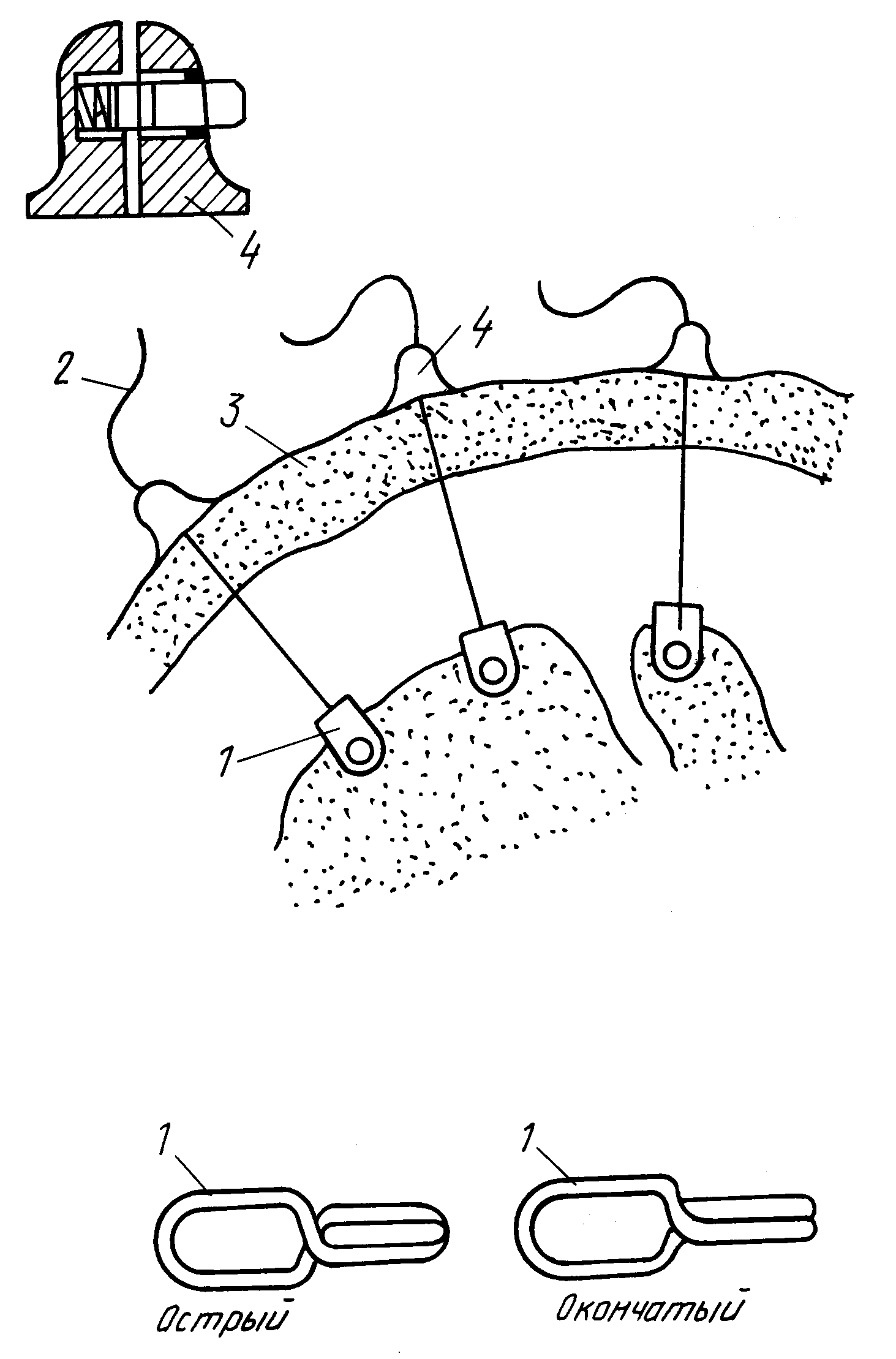
The drawing schematically shows the way the organ or tissue is fixed and the device for its implementation, and the two types of clamps, end and sharp.
The method is as follows.
Through existing puncture with Troacar Injected into the abdominal or pleural cavity clamp 1 with a thready end, e.g., a lex 2, and enforce it on the domestic body 3, and the line 2 Bringing out with a long needle (No figure shown in the drawing) and secure the lock 4 with a skin-specific focus, adjusting the tension of the line and therefore the position of the fixed organ 3. The method shall be carried out under surveillance through Telescope or Telescreen. Thus, any number of locking devices may be installed to ensure that the required lock-in is maintained 2 Free from lock 4, clamp 1 Checked with a lex 2 It's out of the troakart.
The device used to perform the method of locking the organ or tissue consists of a lock 1 with a flexible thread fixed, e.g 2, and the castle 4 for securing and tensioning the forest 2. For installation clamp 1 on a fixed body 3 It's manipulatored through a troach and attached to the organ 3, and the line 2 long needle (not shown) Take the outside and adjust the tension to the lock 4 with an emphasis on the skin surface of the patient ' s body.