
Application: 97114247/14, 1997.08.20
Date of commencement of report of patent validity: 1997.08.20
Date of application: 1997.08.20
Published: 2002.02.10
Authors: P. V. Trusters.(RU), A.E. Season.(RU)
Patent holders: Society of Limited Liability Endomedium (RU)
Documents cited in the search report:
CARL STORZ "ADDITIONEAL INSTRUMENTS FOR OPERATIONIVE LAPAROSCOPY", 3-90, 26060.
EP 0507622 A1, 04.10.1992. GB 2203045 A, 12.10.1988. SU 719622 A, 15.03.1980
Reference: RU2178992C2_20020210.pdf
Abstract
The invention is a medical technique and is intended for use in common surgical techniques endoscopic surgical, e.g, laparoscopic The instrument consists of a working body with controls, hulls, thrusters and springs, the spring is compressed and retreaded and connected by one end with a fixed handle and another with an axle with a movable handle. The second axis of the movable handle is the connection with the traction of the working body (Parts) instrument when clamping, seizing or other surgical action is performed and the instrument is returned to its original position after the compression force is removed. 1 IL.
Pictures
Formula of invention
Surgical instrument consisting of a working organ, body, thrust, working body handles and springs, with the spring being made compensatory and return, the spring being connected with one end of the instrument and the other end with the axle with a movable handle, the second axis of which is the connection with the propulsion of the working body of the instrument.Description
The invention is a medical surgical technique and is intended for use in general surgical but especially in the endoscopic surgical, e.g, laparoscopic or thoracoscopic operations.
Known (1) multiple surgical instrument type Captures, scissors or clamps, The main disadvantage of these tools is that the clamping force of the working parts of these instruments depends directly on the size of the surgical force applied by the pulley in the pull-down of the arms and the break-up of the arms.
In this case, the force is not controlled and may result in injury to the tissue of the instrument operated or in failure of the instrument.
A surgical instrument is also known (2), containing the working body, body, thrust and handles of the working body, but having a spring that interacts with the handles, ensuring that they are self-started, after the operational action and the surgical effort has been removed. Thus, the surgeon applies the force only by applying the clamp and, when the force is removed, by the application of the spring. However, the use of this tool as well as the use of this tool (1), does not allow control of the compression force of the working parts, and therefore does not exclude injury to the tissue of the instrument being operated or the failure of the instrument. Known tools may have a lock that captures the position of the tool handles.
The essence of the invention is that the proposed instrument has been implemented in a different and completely non-existent way, since it has a compensatory spring spring that provides only the necessary compression force for the working bodies (Parts) The instrument is capable of being clamped, seized or otherwise surgically operated and of re-set after removal of the compression force. This is achieved by the mobile handle through the axle is connected directly to the spring, which is rigidly connected to another fixed handle, and the movable handle is connected to the thrust and can rotate relative to the coupling.
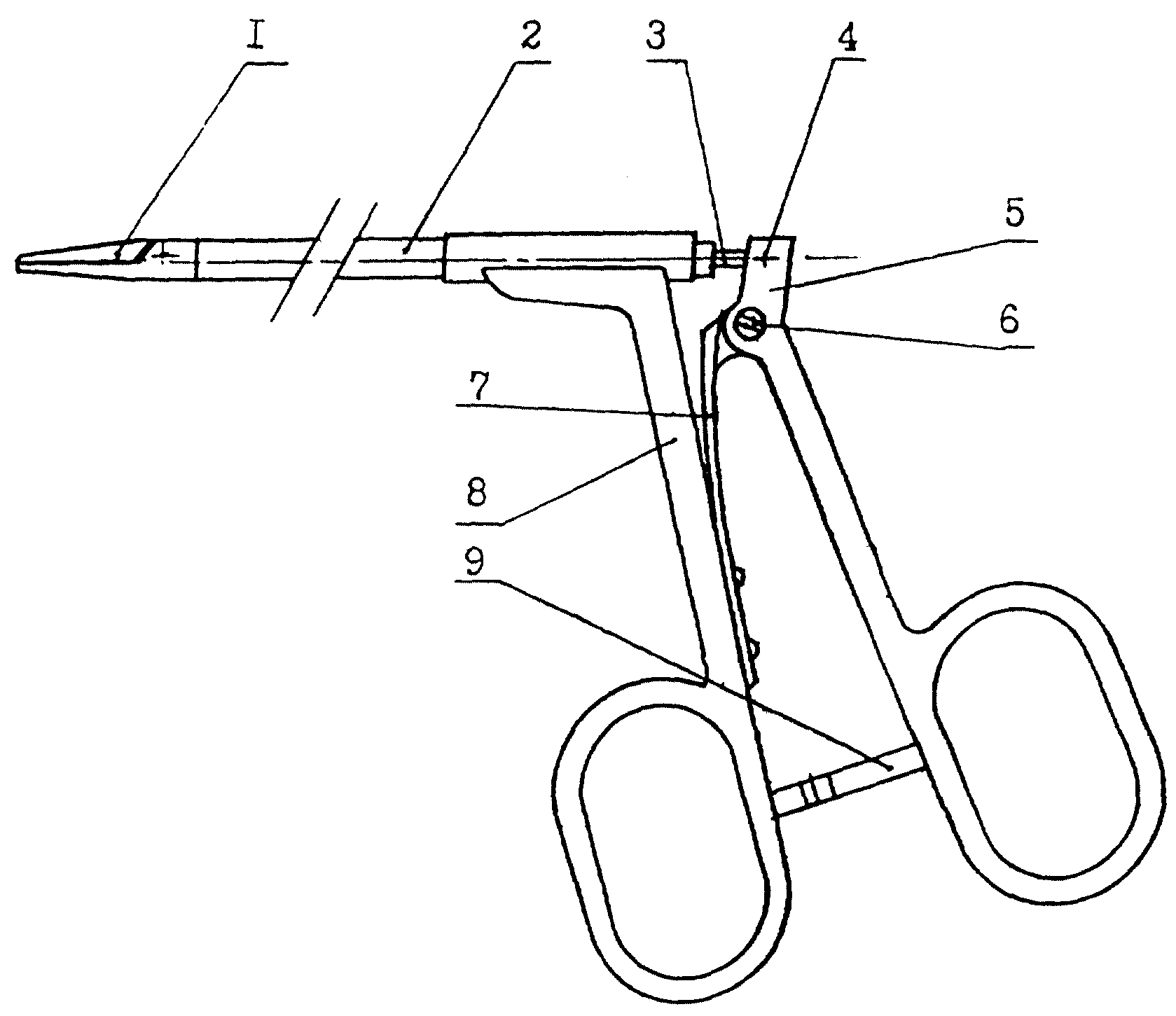
The drawing shows the general type of surgical instrument with compensation-return spring.
The Surgical Instrument consists of a working body 1, Corps 2, in which the movable propulsion is located 3, connected to a working body 1 And through the axle 4 with a movable handle 5, which is through the axis 6 connected to spring 7, other end of which is connected to a fixed handle 8. The instrument may have a lock lock 9.
The instrument is operated as follows: When using a clamping or pulling tool, the surgeon applies a handle compression force 5 and 8 with a movable handle 5 turn first on the axis 6 and its lower part is close to a fixed handle 8, and the upper part of the pen 5 Pulling the thrust 3, moving in the shell 2 and ensure that the open working parts of the working body are connected 1, and therefore capture or clamp the tissue of the operated but further compression of the handles 5 and 8 Instrument: compression force of the organ ' s working parts 1 will not change because the spring 7 with the pen 5 Starts getting close to a fixed pen 8, But now turning on the axis 4 and compensate for the unnecessary force applied to the handle 5, Maintaining the drive position 3, and therefore the force of compression of the organ ' s working parts 1. If necessary, the surgeon may record the position of the working parts when clamped or seized by the locking lock 9, but if the compression force is applied to clamp or seize the tissue of the operated lock to remove and release the lock lock fixation 9, That pen 5, And it's a drag 3 and working parts of the body 1 under spring 7 Return to their original position.