
Application: 95100458/14, 1995.01.11
Date of application: 1995.01.11
Published: 1998.11.10
Authors: P.G. Bugs., Lone V.V., A.E. Season., The Cyclones A.N., Swans of V.A., A.V. Gusaev.
Patent holders: ENDO-MEDIUM Scientific and Production Company"
Documents cited in the search report:
1. DUFNER Instrument GMBH Prospect. 1992, c.21, N 26920-00.
2. SU 980703 A1, 15.02.82.
3. SU 44002 A, 31.08.35.
Reference: RU2121310C1_19981110.pdf
Abstract
The invention is a medical technique and can be used, inter alia, in the endoscopic surgical The body with replacement working movable parts has a pusher, executive organs and handles to hold the instrument and control the executive authorities. Work parts are mounted on the hull with the possibility of turning and locking, and the handles are mounted on the horn-in-hand of the shell and the pusher. The pass of the handles are fitted with sliders, which are placed with the possibility of interaction through the toothed sectors with the toothed ducts of the shell on the press and the pusher. The spring and the pusher provide changes to the position of the controls connected by the cremaller through the trigger and the spring, which allow the movement and fixation of the handle of the executive authority. The shell is sealed with a duct that serves as an axis for the pusher with the other duct (blades, scissors, clamps, pins), with the required spatial and operational position of the surgeon, and with a slight removal of the lock when moving from "chilled" to "chilled" position of the executive authorities". 2 C.E.P.L, 3 IL.
Formula of invention
1. Surgical instrument in the form of scissors, pins or clamps containing a shell with replacement working movable parts fitted with the possibility of turning and locking, a pusher, an executive and a handle for holding the instrument and controlling the executive, different from the fact that the pusher and the shell are fitted with handles in the pasies of which the sliders are placed, with the possibility of interaction through the tooth-twinned sectors of the stomped body sleeves of the body, when the spring and the pusher are pushed, which alter the position of the control handles, which are connected by the cremaller through the trigger and the spring, which allow the movement and fixation of the handle of the executive authority, one slice is locked in the shell and serves as an axis for the pusher with the other duct.
2. Instrument on.1, different that the working surface that perceives the effects of the surgeon's finger is the internal surface of the handle loop that is connected through the axis to the handle cremaller that controls the executive branch.
3. App tool.1 and 2, different from the internal surface of the cremallers being made with a toothed radius allowing movement along the relative loop of the hinge fixed to it by the control handle.
Description
The invention is a medical instrument designed for use in surgical operations and in particular in the endoscopic surgical Operations.
Known (1) A variety of surgical instruments, such as scissors, pins and clamps, containing working movable parts, the body and the tools holding and the handling of movable parts by the hands of a surgeon, with the working executives of the movable parts permanently in the same plane as the steering hands, and therefore not capable of changing the position of the surgeon ' s arm when the executive is fixed.
Surgery tool known and used (2) The type of scissors, clamps, pins that contain a wheel, which the surgeon turns around to change the position of the executive authorities relative to the axis of the instrument, without changing the position of the surgeon's arm or changing, which is the disadvantage of this instrument.
Another disadvantage of the prototype tool is the design of the node of the lock of the executive in the position of use, for example in the "cuffed" position, because in order to remove the fixation and move to the "crunch" position, the surgeon's fingers must overcome significant resistance by distorting and rearing the handles, without excluding finger fractures in the distortion and, consequently, possible traumas to the tissue of the clamped executives.
The essence of this invention is expressed by the following set of significant features that provide the surgeon with the comfort of working with an instrument that can choose any convenient position of the surgeon's hand vis-à-vis the executive authorities (Scissors blades, sponge, clamps, pins) with the required spatial and operational position of the executive and the easy removal of the fixation from the "chilled" position to the executive position "chilled".
This is achieved by having a surgical instrument of the type of sheaths, pins or clamps containing a shell with replacement working movable parts fitted with the possibility of turning and locking, a pusher, executive organs and handles to hold the instrument and control the executive, on the pusher and on the shell on the hornets of the hornets, fitted with the handles in the belly, placed in the belly of the sliding areas with the sniffling branches of the shell, when the spring and the pusher are pressed, changing the position of the control handles, connected by the cremaller through the trigger and the spring, which is capable of moving and locking the handle of the executive control, with one piece of the slice in the shell and serving as an axis for the pusher with the other side of the body, while the working surface that perceives the influence of the finger of the surgeon is the inner surface of the handle of the handle, which through the axis is connected to the crember handle of the handler, the pressure of the handler with the pressure of the executive branch, the internal surface of the handle of the handle, the internal surface of the handle of the control of the handle of the direction hand, the internal surface of the direction of the direction of the direction of the direction hand, the control of the direction of the direction.
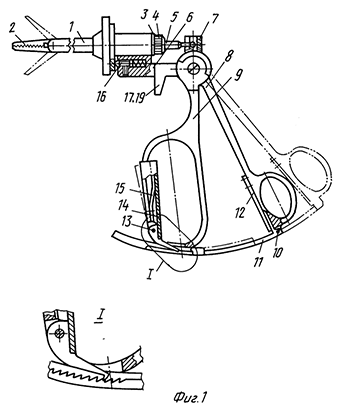
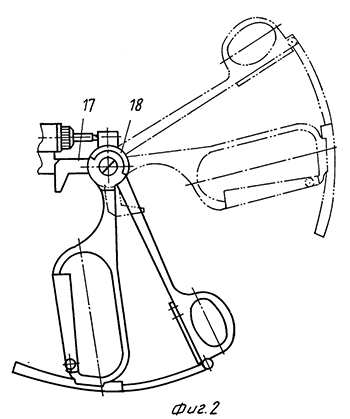
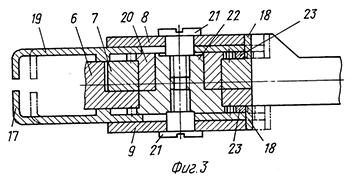
Fig. 1 shows the instrument in the position in which handles 8 and 9 operate working element 2. Fig. 2 shows the position for adjusting handles 8 and 9 relative to the instrument. Fig. 3 shows the mechanism used to adjust the position of handles 8 and 9 in Fig. 2.
The surgical instrument shown in Figs. 1, 2 and 3 consists of an interchangeable working assembly 1 with operating elements 2, such as scissor blades or the jaws of clamps or forceps, and a mechanism for actuating them. Working assembly 1 fits into a slot in housing 6 of the actuating mechanism. Actuating rod 5 enters a slot in the sliding actuator 7. Washer 3 and nut 4 secure the assembly against axial movement in the housing. Working assembly 1 and operating elements 2 can rotate about the longitudinal axis and are secured in the required position by locking device 16.
The control consists of a hull 6 With a closed-capped duct 22, with a snout crown 22 is the pusher axis 7 With a closed-capped duct 20, which also has a toothed crown on the pusher and on the hull on the screw-axis 21 Hands installed 8 and 9, In whose bellies are crawling 17, 19 with stomp sectors 23. Dental sectors 23 spring-activated 18 enter into a chain with the mittens of the ducts 20, 22 of the pusher and the shell, ensuring the stability of the handles 8, 9 Concerning the pusher and the shell 8 on axles 10 Cremaller installed 11, which is spring-y 12 Always leaning on the pen 9. On the pen 9 on axles 13 trigger set 14, which is spring-fed 15 Always toasted to the cremaller 11, By going into the cremaller teeth with your hook.
The surgical tool is designed to operate as follows: The surgeon takes the tool so that the thumb is placed in the handle loop 8, Medium, nameless and pinky in the handle loop 9, index finger on the handle surface 9. The back side, the back, the middle finger, the surgeon pulls the trigger 14, with spring pushed off 15 and trigger 14 Easy and free to leave the cremaller chain 11. Hold the trigger 14 So, when you're down, the surgeon's making the handle move 8, Managing the Executive 2 of the instrument, providing for the position of "chamber" or "crushed" and their fixation.
In Figs. 2 and 3, the surgeon presses sliders 17 and 19 simultaneously with the index finger. This compresses springs 18 and disengages the toothed sectors 23 on the sliders from the toothed rims of bushings 20 and 22 of the sliding actuator 7 in housing 6. While holding sliders 17 and 19 down, the surgeon moves handles 8 and 9 to the required position and releases the sliders. Springs 18 return the sliders to their original position. Toothed sectors 23 on sliders 17 and 19 engage the toothed rims of the housing and actuator bushings, locking the handles in place. The surgeon can repeat this adjustment as needed.